
Heat Pump Backup Heat vs Electric Heat Strips for Point Clear Installs
Choosing backup heat for a Point Clear heat pump install — electric strips versus a gas or propane furnace pairing, and which suits a large bayfront estate.

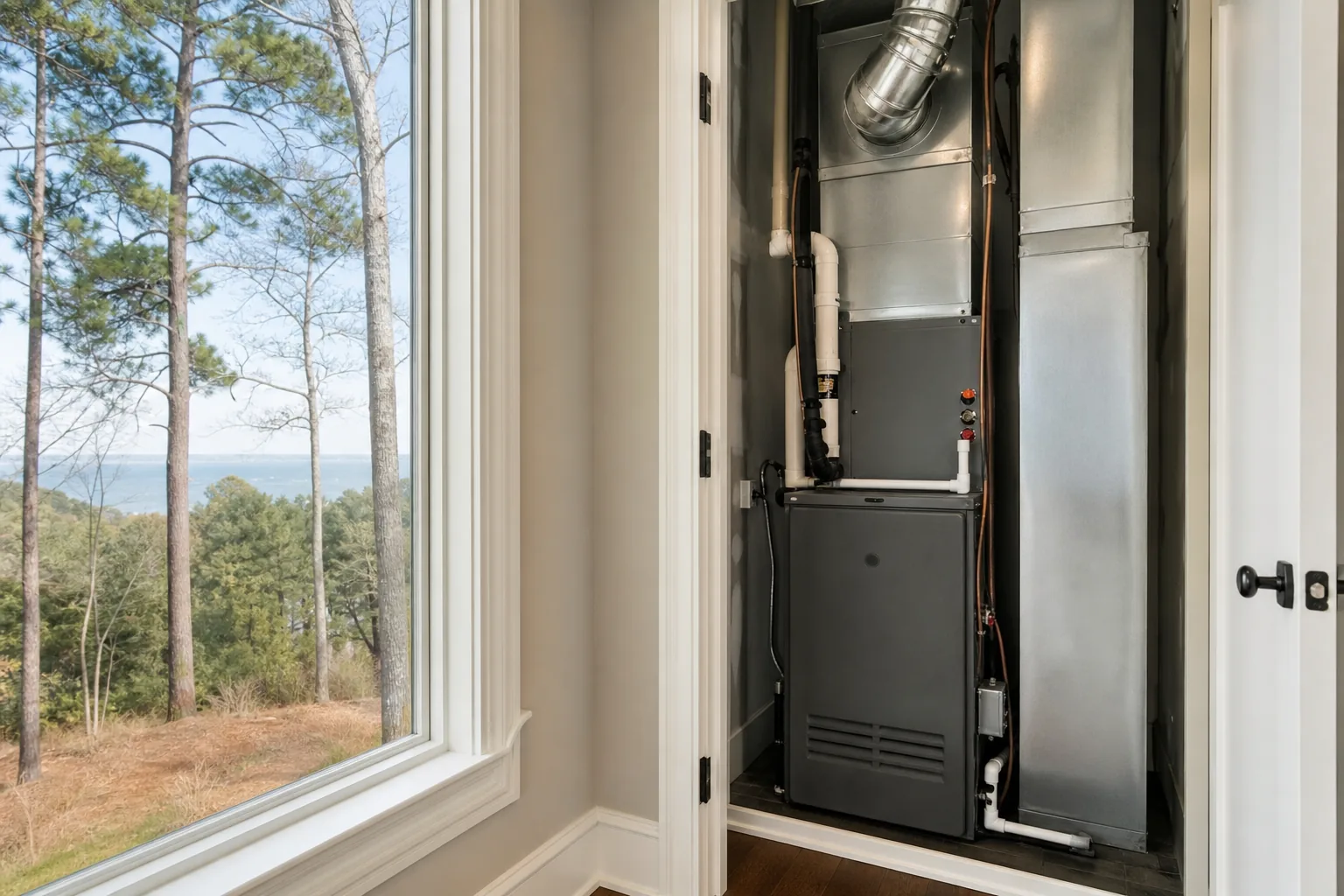
Point Clear is its own world — the historic resort stretch along the bay, the Grand Hotel anchoring it, the Point Clear Historic District running down to the Mobile Bay shoreline in this corner of Baldwin County. The estate homes here have the kind of square footage that asks a lot of a heating system. When you install a heat pump on a property like that, there's a decision tucked inside the install homeowners often miss: what kind of backup heat does the heat pump get? The two common answers behave very differently, and on a large estate the difference is worth understanding.
Why does a heat pump need backup heat at all?
A heat pump heats by moving warmth from outdoor air into the house. It's efficient and it's the right primary heat for our climate. But on the coldest mornings, when there's less heat in the outside air to gather, a heat pump's output tapers and it may need help reaching your setting quickly. That help is the "backup" or "auxiliary" heat. Almost every heat pump install includes some form of it. The question is which form.
Option one: electric heat strips
The most common backup is a bank of electric resistance heating elements built into the air handler — heat strips. When the heat pump needs a hand, the strips energize and add warmth. They're simple, they have no combustion, and they cost less to include in the install. Their downside is operating cost: resistance heat is the least efficient way to make warmth, turning each unit of electricity into exactly one unit of heat with no multiplication. For the brief periods they run in our climate, many homeowners find that acceptable.
Option two: a furnace as the backup (dual fuel)
The other approach pairs the heat pump with a gas or propane furnace instead of strips — a dual-fuel system. The heat pump handles everyday heating, and when it's truly cold the furnace takes over with hot, fast output. On a large Point Clear estate, that furnace-grade heat can recover a big, high-ceilinged home more aggressively than strips will, and combustion heat costs less to run than resistance heat when it does fire.
A heating installation on an estate-scale home is where this distinction earns its keep, because there's simply more space to bring up to temperature on a cold morning.
How a large estate tips the decision
For a smaller, well-sealed home, electric strips are often plenty — they rarely run, and when they do it's brief. The calculus shifts as the home gets bigger and grander.
A large estate has more volume to heat, often more glass, and frequently higher comfort expectations. On the coldest days the backup may carry more of the load and run longer, which makes both its recovery speed and its operating cost matter more. That's the situation where a furnace backup can be worth the higher install cost: stronger output for a big space and lower running cost during the cold stretches when it actually works.
A clear way to choose
Here's how I'd frame it for a Point Clear homeowner.
Gauge how hard your coldest days are on the house.
A big home with lots of glass leans on backup heat more during a freeze than a compact, tight one does.Weigh install cost against operating cost.
Strips cost less to install and more to run; a furnace pairing costs more up front and less to run when it fires. Your home's size and your time horizon decide which wins.Confirm the fuel for a furnace backup.
No natural gas main usually means propane, so a furnace backup involves a tank and line — worth settling before you commit to dual fuel.
The resilience angle on the bay
There's one more consideration that tends to matter on a Point Clear property: what happens when the power flickers. Both a heat pump and its electric strips depend entirely on the grid, so an all-electric setup is only as available as your electric service on a stormy night. A furnace backup still needs electricity for its blower and controls, but if you've paired the estate with a standby generator — and many larger bay-area homes have — a propane furnace can keep producing real heat on generator power more comfortably than a bank of resistance strips, which are heavy electrical loads in their own right. That doesn't decide the question by itself, but for a homeowner who values keeping a big house warm through an outage, it's a genuine point in the dual-fuel column. It's the kind of thing worth raising during the design conversation, because the best backup choice depends partly on how you've planned for the days when the lines go down.
Don't skip the controls
Whichever backup you choose, the controls matter as much as the hardware. Strips that energize too eagerly run up the bill for no reason; a dual-fuel system needs a thermostat that actually knows when to hand off to the furnace. A well-configured install only calls on backup heat when the heat pump genuinely needs it, and not a moment sooner. Getting that logic right is part of a thoughtful installation, not an afterthought.
The short version for Point Clear: electric strips are the simple, lower-cost backup that suits many homes, while a furnace pairing can be the smarter choice for a large estate that demands strong, efficient heat on the coldest days. The right answer depends on your home's scale and how you live in it. We install heat pumps with both kinds of backup across the Eastern Shore — see our HVAC coverage in Point Clear — and we're glad to size it to your property. Call (251) 300-9817 or book a consultation in Point Clear.
Related reading
- If you're weighing a full dual-fuel setup, our walkthrough on dual-fuel heating installation for Perdido homes covers how the heat pump and furnace share the work.
- Managing a multi-building bayfront property? See HVAC for Point Clear estates and resort properties for the fleet-level approach.
- For the cooling side of an estate install, coastal-grade AC installation for Point Clear estates explains how salt air shapes the equipment spec.