
Dual-Fuel Systems for Perdido Homes: Pairing a Heat Pump With a Furnace
How a dual-fuel install works for rural Perdido properties — a heat pump for everyday heat, a furnace for the cold snaps, and the switchover logic between them.

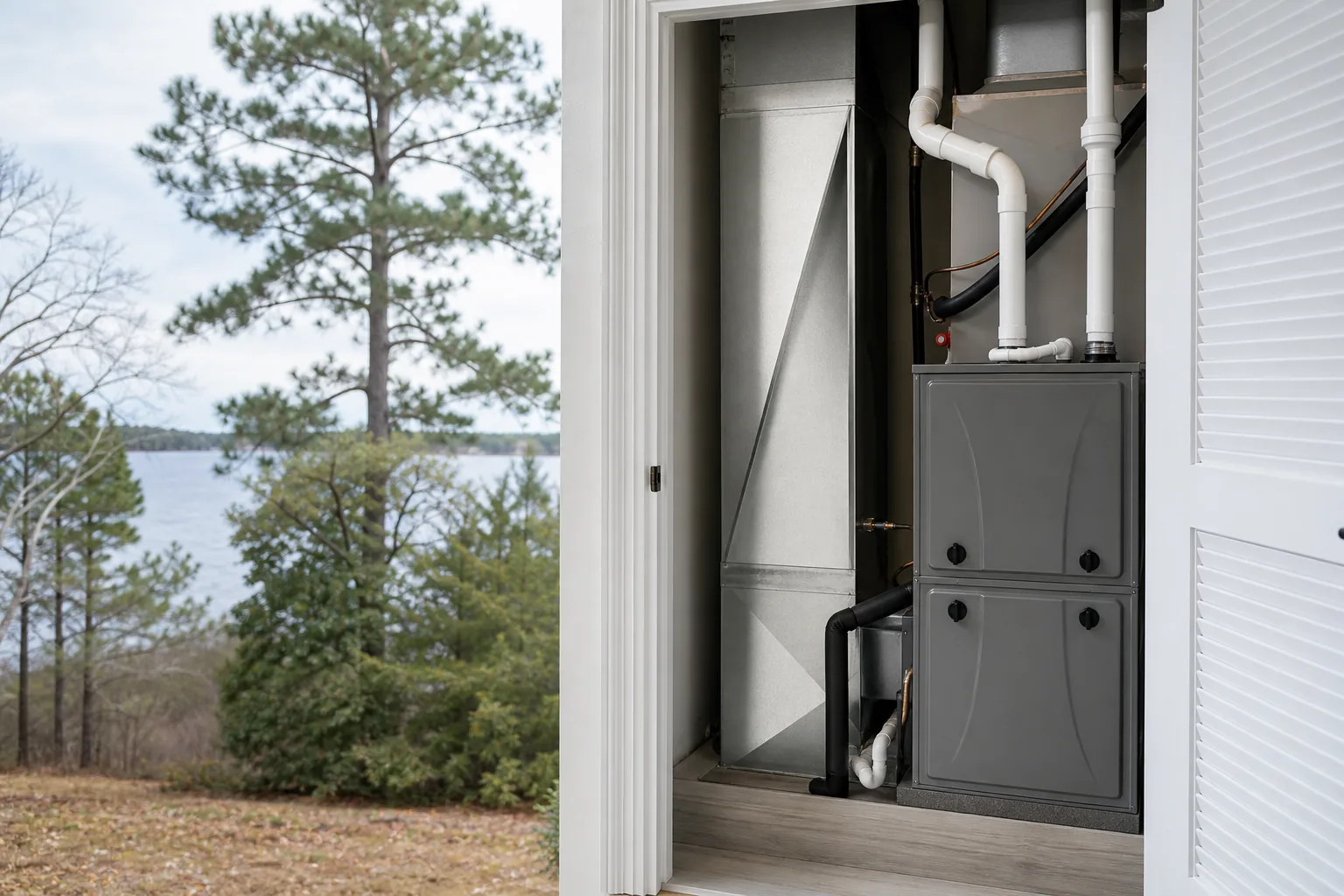
Drive out toward the Perdido River corridor, up in this far-northeast corner of Baldwin County near the Florida line, and the lots get bigger, the trees get thicker, and the gas main runs out long before your driveway does. That combination — rural Perdido acreage, propane instead of piped gas, and a stretch of road that doesn't always keep power in a storm — is exactly the setting where a dual-fuel heating system stops being a luxury upgrade and starts being a genuinely smart fit. Here's how it works and who it's actually for.
What "dual fuel" means in one sentence
A dual-fuel system is a heat pump and a furnace installed together, controlled by one smart thermostat that decides, hour by hour, which one should be running. That's it. You're not running both at once. You're letting the system pick the cheaper, more efficient option for the conditions outside.
The switchover, explained
The heart of a dual-fuel install is the balance point — the outdoor temperature at which the thermostat hands the job from the heat pump to the furnace. Above that temperature, the heat pump does the work, quietly and efficiently, which on the Gulf Coast is most of the winter. When a real cold front pushes through and the mercury drops below your balance point, the system shuts off the heat pump and lights the furnace, which blasts hot air until the cold passes. Then it switches back.
You set that crossover with your installer based on your equipment and what propane costs you. It's not a guess; it's a number we dial in.
Why does this fit Perdido specifically?
Out here, three local realities line up to favor dual fuel.
First, propane, not natural gas. With a tank in the yard, every gallon you burn is metered against a delivery price. A dual-fuel setup leans on the electric heat pump for the bulk of the season and saves the propane for the handful of genuinely cold days — so your tank lasts and your delivery schedule relaxes.
Second, distance and weather exposure. Far-east Baldwin near the river can take a hard freeze, and a heat pump alone leans harder on backup heat when it's truly cold. The furnace side of a dual-fuel system is that backup, and it's a stout one.
Third, the everyday economics. Heating installation on a big rural footprint means a lot of cubic feet to keep warm. The heat pump's efficiency over a long mild season is where the real savings accumulate.
Where dual fuel is overkill
I'll be straight with you, because dual fuel costs more up front than a single system and it isn't for everyone out here.
- If you almost never feel the need for furnace-hot air and you're comfortable through our cold snaps, a straight heat pump may be all you need.
- If you don't have or want propane at all, dual fuel doesn't apply — you'd look at a heat pump with electric backup instead.
- If you're on a tight budget and plan to move within a few years, the payback window on the second appliance may not arrive before you do.
A good installer should be willing to talk you out of it when the numbers don't support it.
How an install comes together
For a Perdido home moving to dual fuel, the work usually breaks down like this:
Size both halves to the home.
A real load calculation sets the heat pump tonnage and the furnace output so neither is oversized — oversizing short-cycles equipment and wastes the efficiency you paid for.Confirm the propane side.
Tank capacity, line, and furnace rating all have to match. Propane equipment is set up differently than natural gas, so this gets verified, not assumed.Set and test the crossover.
The smart thermostat is programmed with your balance point, then we run the handoff both directions to confirm it switches cleanly.
Living with two appliances
It's fair to ask what dual fuel means after the install crew drives off. The honest answer: you now own two heating appliances, and both want occasional attention. The heat pump gets its seasonal once-over like any heat pump, and the furnace side wants its own check, including a look at the combustion components, since it does fire up during cold spells. That's a touch more upkeep than a single system, but it's modest, and a dual-fuel setup spreads the wear — neither machine runs every hour of the season, so each tends to age a little more gently than a lone system carrying the whole load. For a Perdido household that values both efficiency and a strong hedge against a hard freeze, that tradeoff usually reads as reasonable rather than burdensome. Folding the seasonal checks into a maintenance plan keeps both halves in spec and the warranties intact.
The questions to ask before you buy
Ask your contractor what balance point they're recommending and why. Ask how the furnace is rated for propane versus natural gas. Ask whether the thermostat they're installing actually supports dual-fuel logic, because not all of them do, and a dual-fuel system with the wrong thermostat just runs as two confused machines.
If you're weighing a heat pump, a furnace, or the pairing of the two on a Perdido property, we install and configure dual-fuel systems across the eastern edge of Baldwin County and we're glad to look at your specifics. Call (251) 300-9817 or request a dual-fuel consultation. The whole point of the system is to spend less by being smart about which machine runs when — and getting that crossover right is the job.
Related reading
- Choosing gas, electric, or a heat pump for a Stockton home — the upstream fuel-access decision that points many rural homes toward dual fuel.
- Heat pump backup heat vs. electric strips for Point Clear installs — the other way to cover the cold days when you don't have propane.
- The best time of year to install heating in Foley — why planning the install in the calm months gives the load calc and crossover the time they deserve.
- Are heat pumps worth it here? — the case for the heat pump half of a dual-fuel system in our climate.
- HVAC rebates and incentives for Baldwin County homeowners in 2026 — what's actually available now to offset a new system.