
Summerdale Heat Pumps: Why Old Controls Lean Too Hard on Backup Heat
On older rural Summerdale heat pumps, oversized strips plus a dated thermostat can quietly run up the electric bill. Here's why, and what to check.

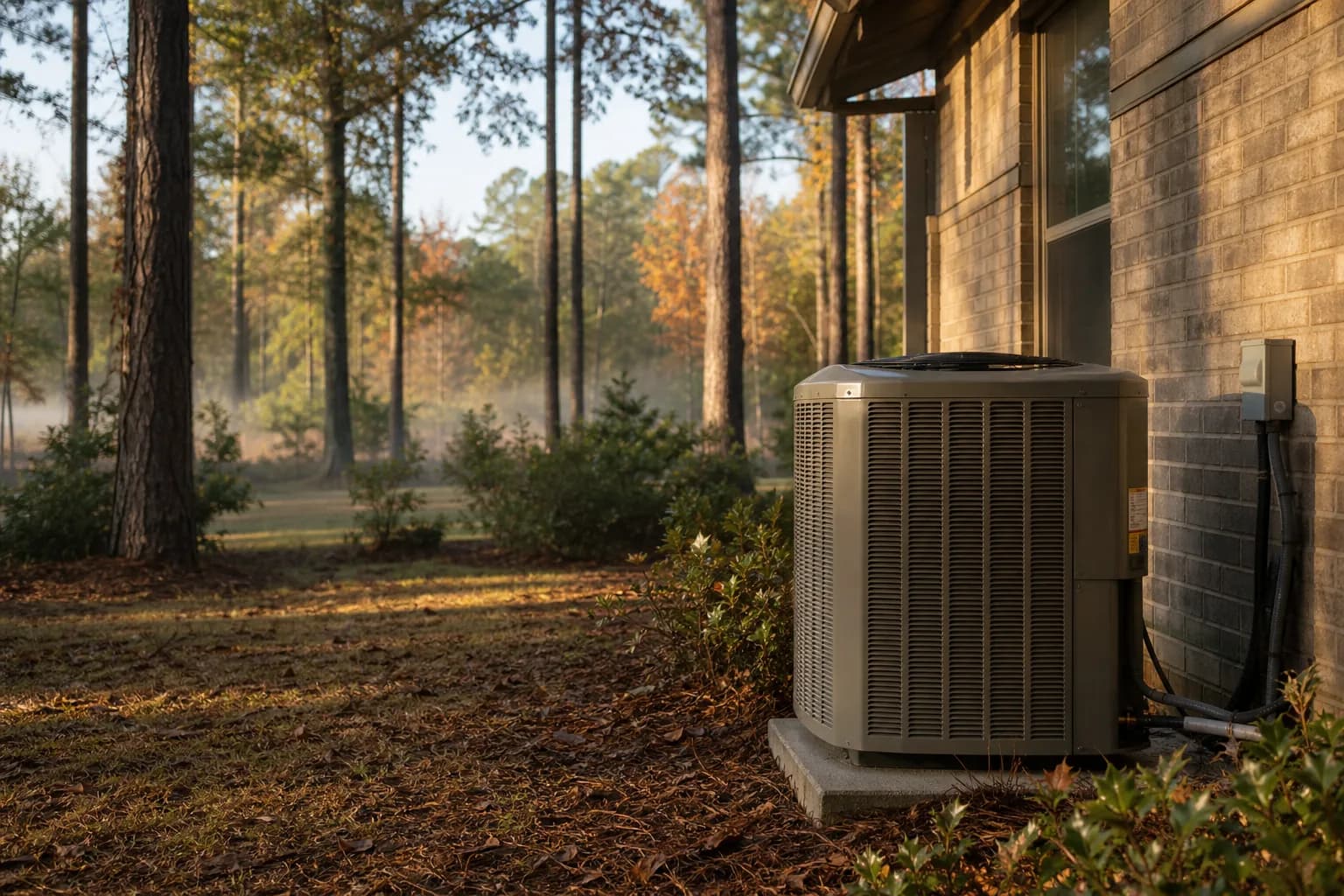
A lot of the homes along the Hwy 59 corridor and the county roads around Summerdale have run the same equipment for a good while. Out here near Downtown Summerdale and the Track Family Recreation Center area, on the older farmhouses and bigger lots, it's common to find a heat pump fifteen winters deep paired with a thermostat just as old. That's usually where the trouble starts. The most surprising power bill a homeowner on rural Summerdale ag land gets is rarely from a dead compressor. It's from a perfectly running system quietly throwing the job to its electric backup coils because nothing ever told it not to.
Let me walk through why aging equipment drifts toward the expensive heat, and what you can look at before you assume the whole unit needs replacing.
The backup coils, and why size matters out here
Every heat pump comes with a second way to make heat. Behind the main blower sits a stack of electric resistance elements, basically heavy-duty heating wire. They produce warmth by burning through a lot of electricity, and they are meant to be a safety net for the rare stretch when the outdoor temperature drops far enough that the heat pump alone falls short.
On a lot of the older rural installs we service, those backup elements were sized generously. The installer years ago put in a big bank of strips, sometimes more kilowatts than a Baldwin County house ever truly needs, on the logic that bigger is safer. The problem with oversized backup heat is simple: when something nudges those strips on, they pull a heavy electrical load every single minute they run. A bigger bank does not warm your house any smarter. It just costs more per hour to keep lit, and on a tired thermostat it tends to stay lit far too long.
How does a dated thermostat hand over the whole house?
This is the heart of it for Summerdale's older systems. A modern control is supposed to be stingy with the backup coils, only allowing them below a chosen outdoor temperature and giving the compressor first crack at every heating call. It's part of why we say heat pumps are worth it in this mild climate — but only when the controls let the compressor do its job. Older controls were not built that simply.
Some of the dated thermostats we still find on rural properties have no idea what the outdoor temperature even is. They cannot lock the coils out, because they have no sense of when locking them out would matter. So their logic is crude: if the house is a couple of degrees below where you set it and is not climbing fast enough to suit the control, bring on everything at once, compressor and strips together. On a chilly but mild morning, that is the strips burning money for a job the compressor could have handled alone given a few extra minutes.
The other failure mode is mechanical age inside the control itself. Worn relays and sticky contacts can let the backup circuit energize when it was not asked to, and on the oldest mercury-bulb models the staging is so coarse there is barely any gap between gentle heating and full backup. The house feels fine. The meter spins anyway.
The emergency switch nobody flipped back
Almost every thermostat, old or new, has an emergency-heat position. People misunderstand what it does. It does not give you a faster, warmer house. It shuts the efficient compressor completely off and runs the home on nothing but those costly resistance coils.
Out on the rural properties this happens more than you'd think. The compressor made an odd noise one cold night a couple of winters back, somebody flipped the system to emergency to limp through, and the switch never went back to normal. From that day forward the home has been heated entirely by its most expensive method, and the homeowner has no idea, because the house stays warm and nothing looks wrong. The only clue is the bill. If your system has an "Em Heat" or "Emergency" setting, the first thing to confirm is that you are not living on it by accident.
Reading the warning signs before the bill arrives
You do not need tools to catch most of this. You need to pay attention for a few cold mornings:
Find the backup indicator
Most thermostats show an 'aux' or 'auxiliary' light or word when the coils are running, separate from the emergency setting. Learn where yours shows it.Match it to the weather
If that indicator is on when it is only down in the forties outside, the coils are doing work the heat pump should be doing for a fraction of the cost.Put a hand near a supply vent
Backup heat tends to feel noticeably hotter and drier at the register than the gentle, steady air a heat pump alone produces. A blast of very hot air on a mild day is a hint.Watch your meter or your last few bills
A jump during a stretch of ordinary, not-very-cold weather almost always traces to the backup coils running when they had no business doing so.
What the right fix usually is
Here is the part that catches people off guard, in a good way. When an older Summerdale system is burning through electricity on its backup heat, the answer is almost never a whole new heat pump. The compressor outside is frequently still doing fine. The weak link is the brain on the wall. It's the winter cousin of the high summer power bill — a runtime problem, not a dead-equipment problem.
Swapping a dated thermostat for a modern one that understands heat pumps changes the whole picture. A proper control lets us lock the coils out above a sensible outdoor temperature, widen the gap so the compressor always gets first try, and ease the house back up to temperature gradually instead of slamming on every heat source at once. Many of the newer controls will even tally how many hours the backup ran last month, so you can actually see the savings instead of hoping for them.
Now and then the coils really are firing because the heat pump itself is struggling, and on equipment this age that is worth ruling out. A charge that has slowly leaked low over the years, a reversing valve that no longer shifts crisply into heating, or a worn compressor that has lost some of its punch will all force the backup to carry more of the load than it should. That is a measurement job, not a guess.
Getting it sorted
If your bill climbed and the house never felt cold, do not assume the worst about the equipment. Let us look at your heat pump and its controls first. We will read the thermostat, confirm you are not stuck in the emergency setting, measure the refrigerant charge, and tell you honestly whether you are looking at a thermostat swap or something more. Emergency HVAC service is available if a rural property ever loses heat completely.
Folks who keep their systems on our Cool Club get the backup-heat settings checked during the two seasonal tune-ups a year, which is the easiest time to catch a control that has drifted. Members also get 15% off all AC repairs and 5% off new systems. On an older system, a little attention to the controls often does more for the winter bill than anything else.
Air Solutions Heating & Cooling has been family-run since Reaves Nelson started it in July 2023, licensed in Alabama as AL#23194 with an A rating from the BBB. The office is at 1410 US-98, Suite N, Daphne, and you can reach us at (251) 300-9817.
Related resources
- Heat Pump Services in Summerdale — the local service page
- All the HVAC work we do around Summerdale
- What the Cool Club includes — seasonal tune-ups and member savings