
Heat Pump Auxiliary Heat Strips: When They Should Kick In (Daphne)
Heat pump auxiliary heat strips in Daphne, AL — when they should engage, when they shouldn't, and why your bill spikes when they're misused.

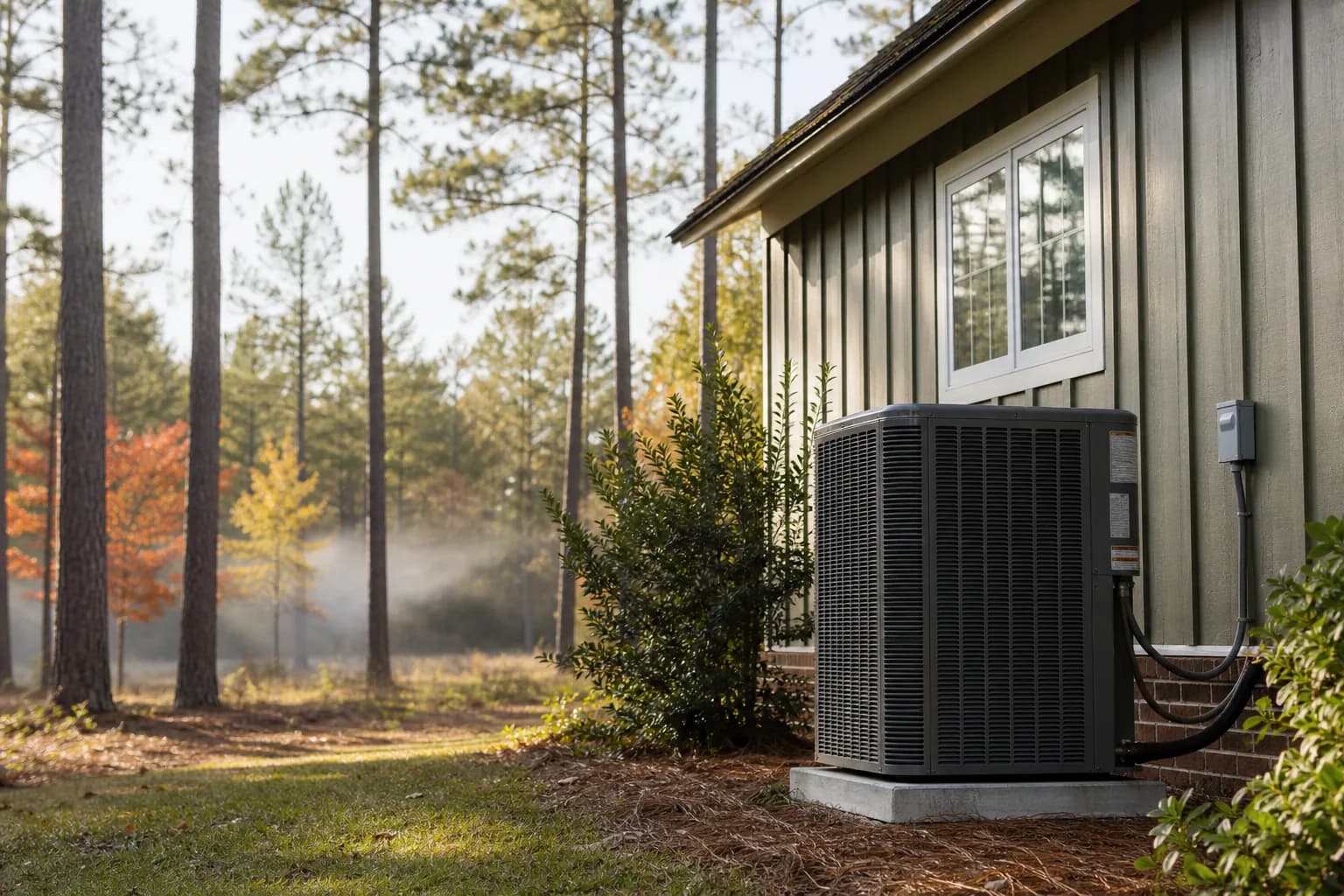
Your Daphne heat pump has auxiliary heat strips. They're expensive when used unnecessarily and critical when needed. Here's when they should run — and when they shouldn't.
What auxiliary heat strips are
Inside your air handler:
- Electric resistance heating elements (like a giant toaster)
- Engage when heat pump can't keep up
- Pure resistance heating (most expensive form)
- Typically 5-20 kW capacity
For a typical Daphne 2,000 sq ft home, the relative cost to operate looks like this:
- Heat pump alone: the cheapest mode by a wide margin
- Heat strips alone: several times more expensive per hour than the heat pump
- Heat pump plus strips together: the most expensive mode of all
So when heat strips run, your hourly operating cost multiplies.
When they SHOULD engage
Legitimate scenarios:
1. Outdoor temperature below balance point
For Daphne typical heat pumps:
- Balance point: ~25-30°F
- Below this: heat pump capacity insufficient alone
- Strips supplement
- This is correct operation
For Daphne, this happens 5-15 nights per winter. Homes right along the Mobile Bay bluffs — Olde Towne Daphne, Montrose, the older streets near the water — tend to stay a touch milder on those nights than the Hwy 181 subdivisions a few miles inland, simply because the bay moderates the overnight low.
2. Defrost cycles
When heat pump defrosts:
- Reverses to cooling mode briefly (to melt outdoor coil ice)
- Cold air would blow indoors
- Heat strips engage temporarily to warm air
- 5-10 minute cycles, several times per cold day
This is correct operation.
3. Recovery from setback
After thermostat setback:
- Large temperature gap (5°F+)
- Heat pump alone is slow
- Strips speed recovery
- Temporary, then disengage
Marginal — programmable strategy can avoid this.
4. Emergency mode (system failure)
If heat pump fails:
- Manual switch to "emergency heat"
- Strips provide all heating
- Expensive but functional
- Use until repair only
When they SHOULDN'T engage (but often do)
Misuse scenarios:
1. Outdoor temperature 35-50°F
Heat pump should handle this without strips:
- Modern heat pumps maintain capacity to 25-30°F
- If strips engage at 40°F, something is wrong
- Common causes: thermostat misconfigured, refrigerant low, sensor issue
For Daphne 95% of winter, no strip operation needed.
2. Quick thermostat setpoint changes
Setting from 68°F to 74°F:
- Triggers "stage 2" heat
- Engages strips
- Expensive recovery
Better: raise setpoint 1-2°F at a time.
3. Aggressive setback recovery
Programmable thermostats:
- Setback to 60°F overnight
- Recovery to 70°F at 6 AM
- 10°F gap = strips engage
- Defeats setback savings
Better: smaller setback (3-4°F) or no setback.
4. Permanent "emergency heat" mode
After test, returning to normal mode:
- Sometimes thermostat left in emergency mode
- All heat is strip heat
- Bills triple
- Common diagnostic
For Daphne homes seeing high bills, check thermostat mode first.
5. Stuck contactor
Failed component:
- Strips engage even when not needed
- Continuous operation
- Massive bill increase
- Requires repair
For Daphne homes with sudden bill spike, contactor possibility.
How to verify what's happening
For Daphne homeowners:
1. Check thermostat mode.
- Should be "Heat" not "Em Heat"
- Look for indicator light
2. Check thermostat schedule.
- Avoid large setpoint gaps
- Smaller setback recommended
3. Watch for "Aux Heat" indicator.
- Modern thermostats show when strips run
- Note when it engages
4. Track at electrical panel.
- Strip circuit (typically 2-pole 60-amp)
- Heat-only circuit (heat pump)
- Note relative use
5. Check utility bill patterns.
- Sudden spike during mild weather = strip misuse
- Cold-week spike = legitimate use
For Daphne homes, smart thermostat with strip-tracking helpful.
Smart thermostat strategy
For Daphne heat pumps with strips:
Settings to avoid strip misuse:
- Compressor lockout: below outdoor temp threshold (e.g., 25°F), only strips
- Aux heat lockout: above outdoor temp threshold (e.g., 40°F), no strips allowed
- Setback amount: maximum 3-5°F
- Recovery time: allow 30+ minutes (smart recovery)
Recommended thermostats:
- ecobee Smart Thermostat Premium — excellent heat pump support
- Honeywell T10 Pro — strong heat pump features
- Nest Learning Thermostat — auto-learns
For Daphne heat pumps, a smart thermostat with proper configuration can shave a meaningful chunk off your winter bill by keeping the strips from running when they shouldn't.
Typical Daphne bill pattern
In a 2,000 sq ft heat pump home, the tell is the shape of your winter bills, not any single number.
Properly configured: December, January, and February bills stay relatively flat, with January a little higher because it's the coldest month. The heat pump carries almost all the load.
Strip misuse (common scenarios): the same three months jump noticeably above the baseline — and the gap is widest in the month the strips run most. That added amount is pure resistance-heat cost the heat pump should have covered.
Over the full life of the system, that month-after-month difference compounds into a real sum — which is why it's worth fixing the configuration once rather than paying for it every winter.
How to test for strip misuse
DIY test for Daphne homeowners:
1. Set thermostat to "Heat."
2. Set 5°F above current. (Should trigger strips initially.)
3. Wait 15 minutes.
4. Set 1°F above current. (Should NOT trigger strips.)
5. Listen + check. If strip indicator on with small change, configuration issue.
6. Watch outdoor temperature. Above 40°F, no strips should engage.
7. Note unusual operation. Strips during mild weather = call.
When to call
For Daphne homeowners:
Schedule diagnosis if:
- Strips engage at moderate outdoor temps (40°F+)
- Continuous strip operation
- Strip indicator stays on
- Bills suddenly higher
- Recovery time excessively long
What the fix usually involves:
- Diagnostic visit to find the cause
- Thermostat reconfiguration — often the entire fix, and frequently the least costly
- Sensor repair, if a temperature sensor is reading wrong
- Refrigerant adjustment, if low charge is forcing the strips on
- Contactor replacement, if a stuck contactor is the culprit
- Strip repair, for a damaged heating element
Most Daphne strip-misuse cases turn out to be a configuration or small-parts fix rather than major work. We'll pin down which one and give you a free quote before proceeding.
Cool Club + strip operation
Air Solutions Cool Club:
- Spring + fall tune-ups verify strip configuration
- 15% off any repair
- Smart thermostat support
For Daphne Cool Club members, strip optimization is part of service.
Heat strip alternatives
If your heat pump struggles:
Option 1: Bigger heat pump
- Install with adequate capacity
- More expensive equipment
- Less strip dependence
Option 2: Cold-climate heat pump
- Maintains capacity to 5°F or lower
- Premium pricing
- For Daphne, often overkill
Option 3: Dual-fuel system
- Heat pump + gas furnace
- Switches to gas at low temps
- Best of both worlds
- Carries a meaningful upcharge over a heat-pump-only setup
For Daphne primary residences, dual-fuel rarely worth it because cold extremes are too rare to recover that upcharge.
Common myths
Myth: "Strips are bad and should never run." Reality: During defrost, 25°F nights, strips do their job.
Myth: "Emergency heat is for emergencies only." Reality: It's a thermostat mode that disables heat pump entirely. Don't use unless heat pump failed.
Myth: "Setting thermostat low overnight saves money." Reality: With heat pump + strips, large setbacks engage strips during recovery. Defeats savings.
Myth: "All electric heating is the same cost." Reality: Heat pump operates at 250-400% efficiency. Strips at 100%. Massive difference.
What's different about heat pumps in Daphne?
Three local factors shape how often those strips should ever come on:
1. Mild winter. As the Baldwin County seat of mild coastal weather, Daphne rarely sees the sustained sub-freezing cold that legitimately calls for strip heat — so for outdoor-temperature reasons, the strips should sit idle most of the season.
2. Coastal moisture. Damp air off Mobile Bay raises how often the outdoor coil frosts up, which means more brief defrost cycles. That's normal, expected strip use measured in minutes — not the hours-long resistance heating that drives a bill up.
3. Bay-moderated micro-climate. A heat pump in Lake Forest or down on the bluffs runs in noticeably milder overnight lows than one up in Bay Minette inland. Same equipment, fewer strip-triggering nights — which is exactly why a misconfigured thermostat stands out so sharply on a Daphne bill.
Ready for heat pump diagnostic in Daphne?
Air Solutions Heating & Cooling provides Daphne heat pump diagnosis + smart thermostat optimization + Cool Club. Family-run, founded in Daphne, licensed AL#23194.
- Schedule Diagnostic — same-day diagnosis
- Call (251) 300-9817 — questions answered
- Heat Pump Services — full overview
Related resources
- Heat Pump Services in Daphne — city-specific service page
- All HVAC services in Daphne — every service locally
- Are heat pumps worth it on the Eastern Shore? — why the coastal climate suits a heat pump in the first place
- Why is my power bill so high? — the warm-season version of the same bill-spike detective work
- How often to change your filter on the Gulf Coast — the maintenance habit that keeps the whole system efficient
- Cool Club Membership — full benefits