
Silverhill Furnaces and the First Honest Cold: A Late-October Readiness Check
Inland Silverhill gets a sharper first chill than the coast. Here's how owners of older central-Baldwin homes should test an aging furnace before late October.
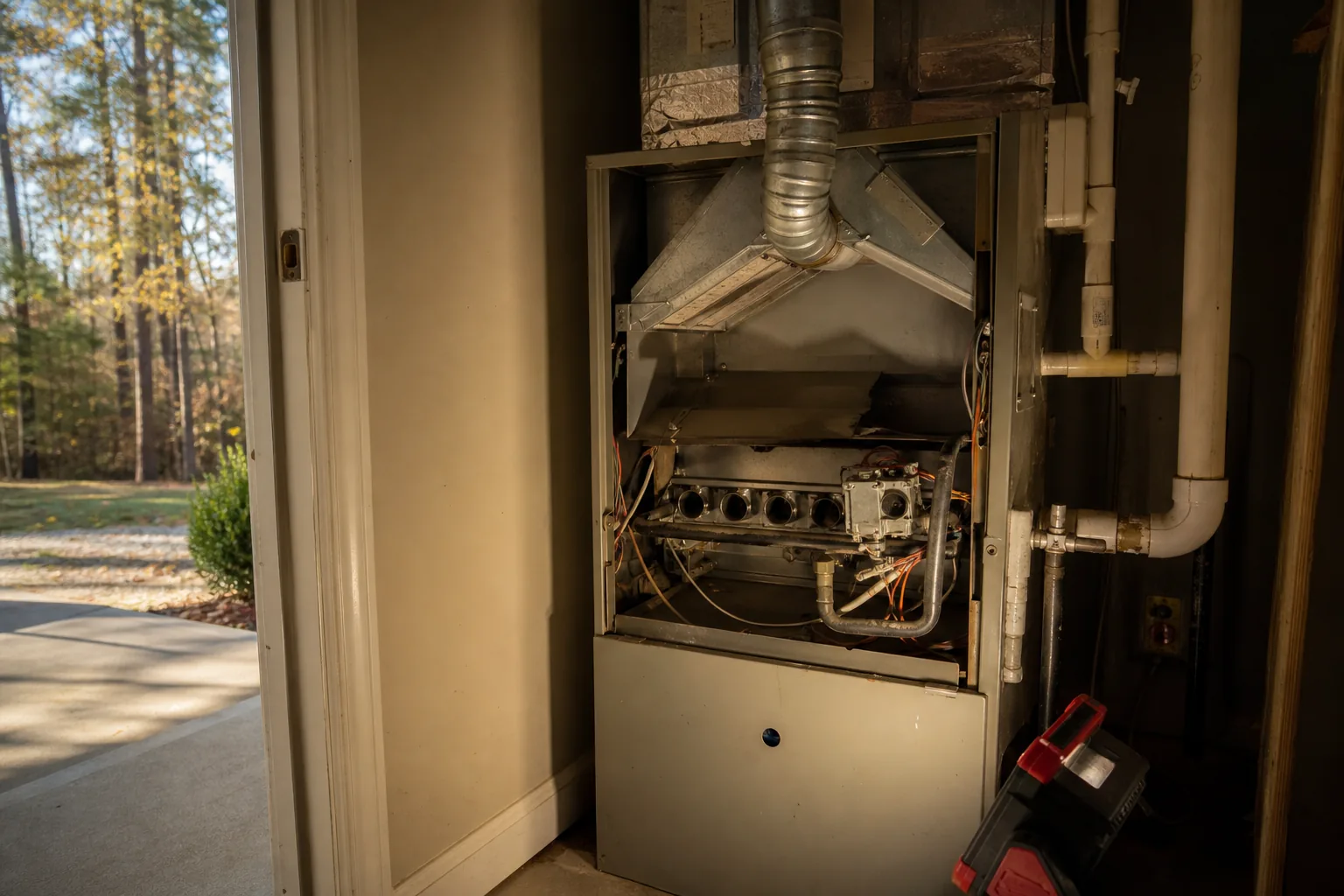
Silverhill sits inland, well off the bay, on farmland that's been worked for generations. That distance from the water matters more than people realize once the season turns. Without the bay nearby to soften the night, the first real cold here arrives a little harder and a little earlier than it does for the beach towns — and the housing stock leans older, which means a lot of these homes are heated by furnaces that have seen a decade or two of winters.
An older furnace in a settled farmhouse is a different animal than a fresh heat pump in a new subdivision. It deserves a different kind of look before the late-October chill. This is a furnace-first readiness check, written for the homes that actually fill this part of central Baldwin.
Why does inland Silverhill bite harder than the coast?
Coastal moderation is a real thing. Water holds its temperature and bleeds warmth back into the night air, which is why a Fairhope bluff stays a few degrees friendlier after sundown than a field off the County Road 55 corridor outside Silverhill. Out here the heat radiates straight up into a clear sky, and a calm autumn night can drop several degrees lower than the forecast for the Gulf Coast shore.
Practically, that means a Silverhill furnace gets leaned on sooner, harder, and for longer stretches than a comparable system closer to the Gulf. The small-town quiet around Downtown Silverhill and out toward the Highway 104 area is lovely, but it also means an aging unit that limped through last winter has another season of wear on it now. The smart move is to find its weak spot in September, not at two in the morning during the first cold front.
Run it once, on purpose, while it's still warm
The worst time to discover a furnace problem is the night you need it. Pick a cool morning weeks ahead and put the system through its paces deliberately. Switch the thermostat to heat and raise the target a notch. A gas furnace should go through a tidy sequence: the inducer fan spins up, the igniter glows, the burners catch with a soft pop, and a moment later the blower pushes warm air down the registers. If you smell a faint scorched-dust odor for the first few minutes, that's just summer's dust burning off the heat exchanger and it should clear quickly. What shouldn't happen: repeated clicking with no flame, a burner that lights and then snuffs out, or a blower that never starts. Let it cycle for fifteen or twenty minutes so anything intermittent has room to act up, then ease the thermostat back down.
The usual suspects, by cause
When an older Silverhill furnace stumbles on its first run, the trouble almost always traces to one of a handful of parts that don't age gracefully. Here's how they tend to present, what's underneath, and the rough shape of the fix.
| What you notice | Likely cause | What it takes |
|---|---|---|
| Clicking, then no flame | A worn-out igniter that can't reach temperature | A common, straightforward part swap |
| Flame lights, then dies | A dirty flame sensor losing its signal | Clean or replace the sensor |
| Blower runs, air stays cool | Limit switch tripping on poor airflow | Usually a choked filter behind it |
| Loud bang at startup | Delayed ignition from gas buildup | Burner cleaning and adjustment — don't ignore this one |
| Nothing at all | Tripped breaker, bad thermostat, or pilot out | Quick checks first, then a service call |
That bang-at-startup symptom is worth singling out. A delayed ignition means raw gas is pooling for a second before it lights, and over time that stress is hard on the exchanger. If your furnace announces itself with a thump, get it looked at rather than living with it. (A furnace isn't the only system that talks — our guide to what those AC noises mean covers the summer side of the same idea.) That choked-filter cause behind a tripping limit switch is also why we harp on how often to change your filter on the Gulf Coast.
Carbon monoxide: the non-negotiable part
Any Silverhill home burning gas for heat needs working CO detectors, and fall is the season to prove they work rather than assume it. Press the test button on each one. Detectors near sleeping areas are the ones that matter most, since that's where a slow nighttime leak would do its harm. The sensing element inside these devices wears out — most are stamped with an expiration date around seven to ten years from manufacture, so check the back of yours. An expired CO detector is a smoke detector that lies to you about the more dangerous gas.
This isn't fearmongering. It's the single cheapest, highest-stakes thing on any furnace-prep list, and it takes two minutes.
A gas furnace and a working CO detector are a package deal. One without the other is a gamble I wouldn't make in my own house.
The thermostat habit that saves a furnace
Once the cold settles in, resist the urge to crank the setpoint way up to "catch up" fast. A furnace heats at one rate whether you ask for two degrees or ten; all a giant jump does is run it flat-out longer — and run the bill up with it, the same flat-out-runtime trap behind a high summer power bill. Nudge the temperature a couple of degrees at a time and let the house come up gradually. Older systems especially appreciate not being asked to sprint.
A note on the Cool Club for year-round homes
Silverhill is full of homes lived in every day of the year, and those systems earn their keep. The Cool Club covers two seasonal tune-ups annually, plus 15% off AC repairs and 5% off a new system. For a household running an older furnace, the autumn tune-up is the one that counts most — a set of trained eyes on the heat exchanger and burners before winter leans on them. Details live on the Cool Club page.
When to hand it off
If your dry run turns up that startup bang, a flame that won't hold, a tripped breaker that keeps tripping, or any whiff of gas, stop and call. Emergency HVAC service is available for the nights a cold front beats your furnace to the punch, and we serve Silverhill and the farming towns across central Baldwin County.
Air Solutions Heating & Cooling is family-run, founded in 2023 and based in Daphne, licensed AL#23194. If your furnace is getting on in years, let us check it before the first honest cold of the season.
- Schedule a furnace inspection — beat the first front
- Call (251) 300-9817 — emergency HVAC service is available
- Heating repair in Silverhill — local service details