
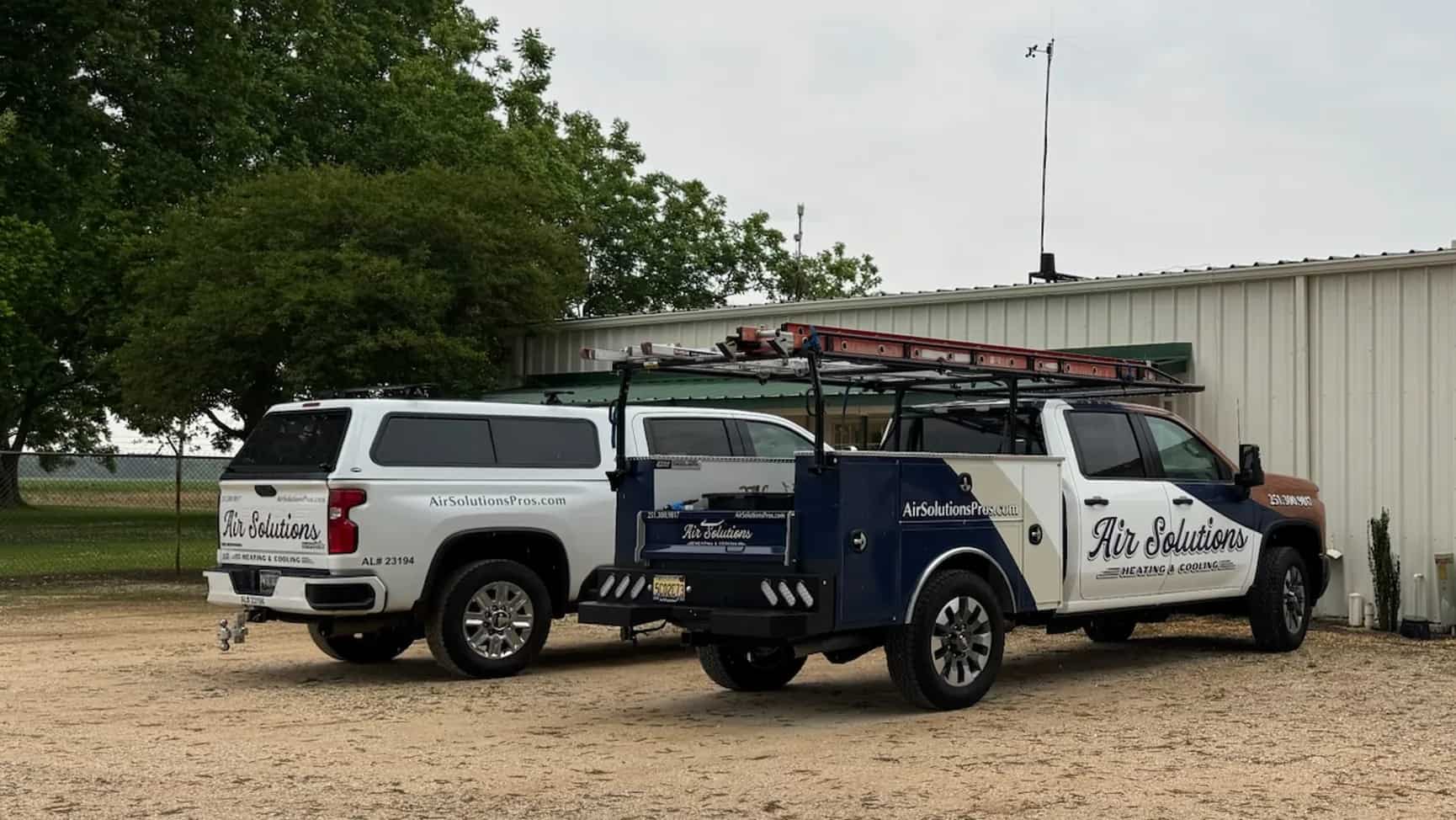
Heating Repair in Stockton.
Local heating repair in Stockton, Alabama and surrounding Baldwin County. Heat pumps, gas + electric furnaces, manufactured home heating. Licensed AL#23194. 353+ five-star reviews. Call (251) 300-9817.
Get a Free Estimate
Name and phone is all we need to call you back. Takes ~20 seconds.
353+ five-star reviews · Same-day · 24/7 · Licensed AL#23194
What heating repair looks like in this climate.
A heating-repair diagnostic on a Stockton address is shaped by a winter that genuinely puts the equipment under load on top of the heaviest cooling season in our coverage area. The per-coordinate ERA5-Land reanalysis at the community's coordinates returns roughly 1,133 heating degree days against a January average daily low near 47.7°F — among the higher heating loads in the matrix, comparable to Bay Minette and Perdido and well clear of every coastal cell. The monthly average hides the cold-snap mornings into the mid-to-upper 20s that arrive several times each winter and drive most of the heating-repair queue. The Peyton-curated city profile pegs Stockton as carrying the longest cold snaps in the county: forty miles inland from Mobile Bay with no Gulf moderation to clip the bottom of the temperature swing, sub-freezing stretches up here last longer and bite harder than the Eastern Shore version of the same regional event.
Stockton equipment also runs against the heaviest cooling envelope in the matrix at the other end of the year — roughly 3,222 cooling degree days, the highest reading we record anywhere — which compounds rather than offsets the heating-repair diagnostic. A heat pump on a 36579 slab delivers more compressor hours through summer than any other matrix address, then immediately swaps into reverse-cycle duty through December and January. Each transition is an opportunity for a marginal component to fail under load: the reversing valve that sat dormant through a warm spring sticks on the first cool-front actuation, the defrost board whose timer drifted strands the outdoor coil mid-melt on a humid 35°F morning, the strip-heat sequencer fuses on a 28°F morning when finally asked to carry sustained auxiliary load, and the R-410A charge that bled off slowly all summer surfaces as heating-mode capacity loss rather than as a noticed cooling-side issue. That cumulative dual-mode stress on aging second-cycle equipment is the load-bearing context for almost every heating-repair ticket we work in 36579.
Cold-snap and storm history that drives the heating-repair call volume in the Stockton community.
- Jan 2024 — Multi-night sub-freezing stretch — rural-acreage no-heat dispatch wave: Three consecutive overnight lows well below freezing with daytime highs that struggled to crack 40°F across north Baldwin — colder and longer than the Eastern Shore version of the same event because Stockton sits inland without the bay thermal moderation that softens a Daphne freeze. The cold-mode runtime exposed every weak point on aging second-cycle 36579 equipment at the same time. Reversing valves stuck mid-cycle on the changeover from cooling. Electric auxiliary heat strips read open at the sequencer on aging packages where one element had degraded silently while the others carried it through warmer winters. Defrost boards drifted under sustained cold-mode runtime. On the propane-furnace dual-fuel configurations a parallel wave of flame-sensor failures, ignition-module faults, and gas-valve sequence issues surfaced on the coldest nights, with a fraction of the calls actually traceable to LP-tank supply-pressure problems upstream of the equipment.
- Jan 2018 — Hard freeze, regional low near 20°F — reference event for the current install cohort: A reference event for the Stockton housing stock that came through it. Heat pumps and strip-heat packages running marginal going into the week turned into no-heat calls once temperatures dropped, and the post-event diagnostic queue stretched for weeks as homeowners discovered freeze-damaged outdoor coils and slow R-410A leaks crossing the symptomatic threshold. A measurable share of the heating equipment installed in the community between 2018 and 2020 traces back to systems that did not survive that week, and that install cohort is now entering its seventh and eighth year — squarely inside the window where reversing-valve actuation count, defrost-board cycle accuracy, and strip-heat sequencer contact condition begin crossing their failure thresholds. The diagnostic call mix today is weighted toward the 2018-2020 install wave on top of the older 2005-2015 second-cycle equipment.
- Sep 2020 — Hurricane Sally — heating-side carry-over from north-Baldwin grid cycling: Sally tracked east of Stockton at landfall, but the outer wind field reached well into north Baldwin and produced extended power outages plus brown-out cycling on the Baldwin EMC feeders serving the community during restoration. The heating-side consequence was not immediately visible — Sally hit in September when nothing was running in heat mode — but it surfaced the following winter as outdoor disconnect boxes that took wind-driven rain corroded internally, contactor surfaces arced on the first cold-morning reversing-valve actuation, and wind-stressed line-set connections produced slow R-410A leaks that read as heating-mode capacity loss over the next two winters.
- Apr 2024 — Spring severe-weather outbreak — voltage-cycling fatigue surfacing the next winter: A regional severe-weather setup brought tornado watches to north Baldwin with high-end straight-line wind, hail, and prolonged grid cycling on the Baldwin EMC north-county feeders. Structural damage inside the community itself stayed limited compared with harder-hit zones farther north, but the post-storm electrical-fatigue carry-over on heating-side hardware was real. Heat pumps that powered through the event without an immediate cooling-side failure produced a delayed wave of reversing-valve and defrost-board faults the following winter when finally asked to swap into reverse-cycle duty against the post-restoration electrical-fatigue history.
What we see on calls in Stockton.
The 2022 ACS pegs the median Stockton home at a 1995 build year, putting the typical address at about twenty-seven years old. The original mid-1990s install is long gone, and the second-cycle replacement that went in somewhere between 2005 and 2015 is what is actually running on the slab today. A meaningful share of those second-cycle units are now eight to seventeen years deep into service against the heaviest cooling load in the matrix paired with a real heating load — squarely inside the window where reversing-valve actuation count, defrost-board cycle accuracy, strip-heat sequencer contact condition, refrigerant charge integrity, and LP-furnace ignition-side cleanliness on the dual-fuel subset all begin to cross their failure thresholds within a single winter of each other. Owner-occupancy across the community runs about 87.6 percent — the highest figure in our matrix — so the diagnostic conversation almost always happens with the long-tenure homeowner who plans to live with the result for years on a rural-acreage property. That framing matters: we walk through what each repair line buys in residual equipment life rather than push a parts-cannon repair that masks the next failure already setting up.
What we find on a typical Stockton call breaks across two diagnostic surfaces depending on what the indoor side is. On the electric-strip-heat backup configuration (the more common setup on the 1995-built housing stock up here), the recurring patterns cluster along a handful of persistent lines. Reversing valves stick on heat pumps past the twelve-year mark, sometimes refusing to actuate on a cool-front pulse and sometimes stalling in a partial-shift mid-state. Defrost boards drift out of cycle spec on outdoor units in the same age band. Strip-heat sequencer contactors pit and arc from heavy-load winter closures, with the resulting voltage drop showing up as reduced output at the registers. Refrigerant charge bleeds off slowly through aging Schrader cores, brazed joints near the reversing valve, flare connections at the indoor TXV, or sun-cracked line-set boots; the resulting undercharge surfaces in January because heat-mode capacity is more sensitive to charge state than cooling-mode capacity. On the LP-furnace dual-fuel configuration (the realistic gas-side pairing on the share of Stockton properties that already keep a propane tank), the diagnostic runs through a different parts catalog: flame sensors fouled after a long warm-season idle, hot-surface ignitors cracked from thermal stress on the initial fire, gas-valve sequence faults that fail safety lockout, and LP-tank-side regulator and supply-pressure issues that read as furnace failures but are actually fuel-delivery problems upstream. A proper diagnostic on either surface reads system data before reaching for parts and puts the actual findings on the invoice.
- Mid-life equipment is the common profile in this area. Capacitor and contactor failures dominate the service-call mix.
- Long cooling season means compressors run heavy May through October. Annual maintenance pays for itself in compressor lifespan.
- Mild winters mean heat pumps cover the season comfortably without backup runtime in normal years. Cold-snap weeks expose undersized units.
Heating Repair in Stockton — the questions that come up.
- Our Stockton heat pump cooled fine all summer but is barely putting out heat after the first cold front. What likely failed?
- The post-warm-spring no-heat call is the most common heating-repair pattern we work on second-cycle Stockton equipment. Three usual suspects walk first. A stuck reversing valve — the body sat dormant in cooling-mode position through a long warm spring, and the first hard actuation to heat mode after a cool-front pulse exposed a corroded shuttle or a sticking pilot solenoid (the system will either continue running in cooling mode in the winter or stall part-way through the swap). A defrost board drifted out of cycle timing spec on an outdoor unit in the same age band, producing ice-on-coil complaints on humid 35°F mornings. Slow R-410A loss surfacing as heating-mode capacity decline — a leak tolerable at moderate cooling-side load becomes symptomatic in reverse cycle because heat-mode capacity is more sensitive to undercharge. A proper diagnostic walks all three before reaching for parts, with refrigerant-pressure readings, a line-temperature check across the valve body, current draw on the reversing-valve solenoid, and superheat-and-subcooling measurements that confirm the actual charge state rather than guess.
- Why does my Stockton heat pump's refrigerant leak only show up as a problem in winter?
- Heat-mode capacity is more sensitive to refrigerant undercharge than cooling-mode capacity, which is why a slow R-410A leak tolerable through July starts producing noticeable capacity drop once the system swings into reverse cycle in December and January. In cooling mode the outdoor coil rejects heat at conditions the manufacturer specified the equipment around for the bulk of the operating year; in heating mode the outdoor coil acts as evaporator at temperatures down into the 30s, and undercharge there starves the compressor of mass flow precisely when the system is being asked to extract heat from already-cold ambient air. Same leak, but it was masked by the easier summer operating point. Common leak locations on Stockton second-cycle equipment: Schrader cores at the service ports, brazed joints near the reversing valve and accumulator, flare connections at the indoor TXV, and line-set penetrations where UV exposure on rural-acreage open-sun outdoor placement cracked the rubber boot. Electronic leak detection and superheat-and-subcooling measurement isolate the leak point before any refrigerant gets added — a top-off without finding the leak buys weeks, not seasons.
- Our propane furnace will not light on a Stockton cold morning. Can it be repaired, and what should we check before calling?
- The LP-furnace winter no-light call is a regular part of the Stockton heating-repair book because the community has no widespread natural-gas distribution. The most common root causes are a flame sensor fouled after a long warm-season idle, a hot-surface ignitor cracked from thermal stress on the initial fire, a gas-valve sequence fault that fails safety lockout, and on the LP-tank side a regulator or supply-pressure issue that reads as a furnace failure but is actually a fuel-delivery problem upstream. Two safe checks before we route a truck up I-65: confirm the LP tank is not empty and the regulator gauge needle is in normal range, and check the thermostat for low-battery indicators. Do not attempt to clean the flame sensor, replace the ignitor, or open the gas-valve sequence yourself — those involve fuel-side safety controls that need to be diagnosed and reset by a licensed tech. Call the booking line, describe the symptom, and we dispatch with common ignition-side parts on the truck for the fifty-minute drive.
- Our Stockton heat pump is past fifteen years old and the repair quote is significant. How do you think about repair-versus-replace honestly here?
- Plainly, with the numbers visible on both sides and the dual-mode load named. Stockton runs the heaviest cooling-degree-day load in our entire matrix (about 3,222 CDD) on top of a real heating load (about 1,133 HDD), so a heat pump on a 36579 slab accumulates more total operating hours per calendar year than the same nameplate on any other matrix address. The practical implication: the repair-versus-replace tipping point arrives a year or two earlier here than on a coastal cell carrying identical equipment. The honest framing on a fifteen-year-old system with a four-figure repair quote walks the immediate repair cost against the realistic next-year repair queue on the same equipment, the current R-410A refrigerant and its parts-availability trend as the industry shifts to R-454B, what prior-year electric bills say about whether the existing system is still earning its operating cost, the rebate paths available on Baldwin EMC (after confirming the meter is on EMC rather than the small Alabama Power edge case). We are not an authorized dealer for any single manufacturer, which removes dealer-incentive pressure from our side of the table.
- Does the Cool Club fall tune-up actually help on a Stockton heat pump given how hard the system works on both sides of the year?
- It tends to pay off more in Stockton than in most of the service area because the equipment runs harder on both sides of the year than equipment anywhere else in the matrix. The fall heating-system visit is the cheap window to catch the failure modes a Stockton heat pump is most likely to develop heading into winter — exactly the marginal-component issues that otherwise wait until a 28°F January morning to surface as a no-heat call on a fifty-minute dispatch from the Daphne shop. The visit covers reversing-valve actuation testing under bench conditions, defrost-board cycle-timing verification before the ice-on-coil call lands, auxiliary heat-strip continuity checked under actual load rather than by static reading, capacitor microfarad readings on outdoor units entering their second decade, refrigerant charge confirmation by superheat-and-subcooling measurement, and on the LP-furnace dual-fuel subset a flame-sensor cleaning and ignition-module check on the bench. The spring AC tune-up covers the cooling-side wear catalog before the matrix-highest CDD load surfaces it. Cool Club covers that twice-yearly cadence plus 15% off all AC repairs and 5% off new systems on any work that does come up, with no long-term contract attached.
What Stockton customers can claim.
- Baldwin EMC carries residential electric service to almost every meter inside the Stockton community footprint, working out of its Bay Minette and Summerdale service areas. The single-provider electric reality matters on every winter heating-repair diagnostic — a truck rolling north on I-65 in January carries common parts for two configurations specifically: heat-pump-with-electric-strip-backup, and heat-pump-with-LP-furnace dual-fuel. The natural-gas-or-heat-pump ambiguity that defines a Foley or Daphne winter dispatch does not apply here. For the small minority of Stockton parcels that fall on Alabama Power instead, the repair work reads identically — only the utility-side rebate paperwork on a follow-up replacement would change, which is why we verify the provider from a recent electric bill before any rebate figure gets written into a quote.
- Heating-repair work itself — reversing-valve service, defrost-board replacement, strip-heat sequencer and contactor swap, refrigerant leak repair and recharge, capacitor work on outdoor units, flame-sensor cleaning and ignition-module replacement on an LP furnace, gas-valve sequence diagnostic and replacement — does not generally qualify for Baldwin EMC residential energy-efficiency rebates. The cooperative's published rebate menu is written around full-system replacement at qualifying high-efficiency tiers, not around parts-and-labor repair tickets.
- Where the Baldwin EMC conversation does become a real line item is on the tail end of a repair-versus-replace diagnostic that honestly concludes the existing equipment has reached the practical end of its service life. Dollar values and qualifying tiers shift annually on the cooperative's own schedule, so we verify the current rebate menu directly through baldwinemc.com before any figure lands in a written replacement quote rather than carry a stale figure forward.
- The federal 25C Energy Efficient Home Improvement Credit expired December 31, 2025 and is not available on replacements placed in service in 2026 or later. Ask your CPA about 2025 return eligibility if qualifying equipment was placed in service before that date.
- Converting a Stockton home from electric heat to natural gas is generally not feasible at the meter because the gas distribution simply does not reach broadly across the community. A property that already keeps an LP tank in service for cooking, hot water, or a propane appliance can legitimately consider a propane furnace as part of a dual-fuel pairing on a future replacement, with operating-cost math run against current LP delivery pricing rather than assumed favorable. For the repair call on whatever hardware is bolted to the slab tonight, the dispatch math runs the same whether the indoor side is electric strip, an air handler with auxiliary heat, or an LP furnace.
Every Stockton neighborhood, every zip.
Heating-repair coverage for Stockton spans the full 36579 ZIP — Downtown Stockton, the Stockton Cemetery area, the rural homes threading along the Tensaw River corridor, the Highway 59 spine running north from Bay Minette into the timber country, and the timber-land parcels wrapping the community on every side. Stockton CDP carries 420 residents per ACS 2022 — the smallest formal community in our coverage area — and the routing math reflects that scale honestly: no local storefront sits inside the community, no dedicated rural on-call truck stages out of it, and the arrival windows a contractor inside Daphne or Fairhope city limits can promise on home territory do not transfer up here. On a cold-morning no-heat call the dispatch geography is the first thing the homeowner needs to hear plainly. The route from our Daphne shop measures 30.9 highway miles up I-65 to the north-Baldwin exits and then north on Highway 59 past Bay Minette into the timber country, clocking at 49.8 minutes on OSRM under normal traffic — round to fifty minutes for honest planning, longer in any condition that adds friction to the interstate or weekend traffic to the route. There is no alternate that materially shortens the distance.
The questions we ask on the booking call — vintage of the structure, whether the heating side is electric strip behind a heat pump or an LP furnace in a dual-fuel pairing, whether the system has been swapping into heat mode regularly or is just being asked to actuate after a long warm spring, whether the failure presented as no heat at all or as gradually-declining capacity — let us route the right truck with the right common parts on a drive that does not give us a second chance. After-hours dispatch routes through (251) 300-9817 monitored continuously, with the on-call rotation returning missed calls as quickly as the queue allows; the realistic ETA on a Stockton heating emergency is dispatch-time plus the fifty-minute drive, named honestly before a truck rolls, and after-hours overtime rates per the published Air Solutions policy are disclosed on the same call. Cool Club membership covers a comprehensive AC tune-up in the spring and a heating-system tune-up in the fall, plus 15% off all AC repairs and 5% off new systems. On a Stockton address the value of the cadence usually shows up most on the heat-mode wear catalog — reversing-valve actuation tested under bench conditions rather than after a cool-front pulse exposed a stuck shuttle, defrost-board timing verified before the ice-on-coil call lands, strip-heat continuity checked under load on a documented November visit instead of by a homeowner staring at a thermostat at 5 AM in January.
- Downtown Stockton
- Stockton Cemetery area
- the Tensaw River corridor
- Hwy 59 north of Bay Minette
- rural Stockton timber land
Heating Repair Coverage Map — Stockton, Alabama
Centered near Stockton for orientation. Air Solutions Heating & Cooling provides heating repair throughout every Stockton neighborhood and zip code, plus the surrounding Baldwin County area. Same crew, same number — we travel the whole county.
353+ Five-Star Reviews. And Counting.
“Jacob was friendly, professional and prompt.”
“Jacob was absolutely wonderful. Definitely would recommend him and this company!!”
“⭐⭐⭐⭐⭐ **Outstanding Service from Air Solutions and Jesse!** I can't say enough good things about my experience with **Air Solutions**, especially their technician **Jesse**. After dealing with my 10-year-old HVAC system, I wanted someone who would actually take the time to diagnose and properly service the system rather than simply recommend replacing it. Jesse exceeded my expectations. He was…”
Schedule Heating Repair in Stockton.
Heat pumps, gas + electric furnaces, manufactured home heating. Same-day appointments most weekdays in Stockton and surrounding Baldwin County. Tell us when works for you — we'll confirm by phone during weekday office hours (8 AM-4 PM).
Need someone right now? Call (251) 300-9817 — our 24/7 emergency line is answered live when we can and returned quickly when we can't.
Heating Repair in Stockton — FAQs
Do you repair heat pumps, gas furnaces, AND electric furnaces in Baldwin County?
Yes — Air Solutions Heating & Cooling repairs every common heating system type in Baldwin County: heat pumps in heating mode (the most common system in Stockton, Bay Minette, Stapleton, Spanish Fort, and surrounding cities), gas furnaces, electric furnaces, and manufactured home heating systems. Same-day service most weekdays; 24/7 emergency line at (251) 300-9817 for cold-snap nights.Why does my heat pump blow cool air in winter?
Three common causes in Baldwin County heat pumps: (1) the system is in defrost mode (briefly normal — check again in 10-15 minutes), (2) the auxiliary heat strips aren't engaging when outdoor temps drop below balance point, or (3) the reversing valve isn't switching from cooling to heating mode. We diagnose all three on the same visit and most heat pump heating issues are repaired same-day.How much does heating repair cost in Baldwin County?
Most heat pump heating repairs fall between $150 and $600 (capacitor, contactor, defrost board, reversing valve solenoid). Gas furnace repairs typically run $200 to $700 (igniter, flame sensor, gas valve, control board). Major component failures (compressor, heat exchanger crack) run higher. We diagnose first, give a written estimate before any work starts, and never start without your approval.Do you service all of Stockton, AL?
Yes — Air Solutions Heating & Cooling covers every neighborhood and zip code in Stockton, Alabama — including Downtown Stockton, Stockton Cemetery area, the Tensaw River corridor, plus the surrounding subdivisions and rural roads. We handle AC repair, AC installation, AC maintenance, emergency HVAC, and commercial HVAC. Standard service hours weekdays, 24/7 emergency response, and same-day appointments most of the year. Call (251) 300-9817 to schedule.What HVAC issues are most common in Stockton?
Homes around the Tensaw River most commonly call us for refrigerant leaks (often salt-air or coil corrosion related on the Gulf Coast), undersized air conditioning systems struggling with Baldwin County summer humidity, and capacitor failures during peak load between June and September. A Cool Club bi-annual maintenance plan catches most of these issues before they cause a breakdown.
Heating Repair Near Stockton.
Right at the Stockton city limit? We service the surrounding Baldwin County communities on the same routes — same crew, same response times.
Related HVAC Guides.
Long-form articles about heating repair and Baldwin County HVAC, with practical advice from our team.
 Maintenance
What a Real AC Tune-Up Includes in Stockton (Not Just Gauge-and-Go)
A thorough AC tune-up for a Stockton, AL home is more than clipping on gauges. Here's the full inspection checklist a real maintenance visit covers.
August 18, 20266 min Emergency
No-Cool Emergencies for Stockton Homeowners: A First-Response Guide
AC down on your Stockton, AL acreage? A rural first-response guide — what to stabilize yourself and how same-day priority routing reaches outlying north-county homes.
July 30, 20266 min
Other services in Stockton & this service across Baldwin County.
- All HVAC services in Stockton, AL
- Heating Repair across Baldwin County
- AC Repair in Stockton
- AC Installation in Stockton
- AC Maintenance in Stockton
- Commercial HVAC in Stockton
- Emergency HVAC in Stockton
- Heat Pump Services in Stockton
- Indoor Air Quality in Stockton
- Ductless Mini-Splits in Stockton
- Heating Installation in Stockton
Heating Repair in Stockton — Schedule Today.
Same-day appointments most weekdays. Cool Club members get prioritized scheduling.