
Ductless Mini-Splits in Stapleton.
Local ductless mini-splits in Stapleton, Alabama and surrounding Baldwin County. Zone cooling for additions, garages, sunrooms, historic homes. Licensed AL#23194. 353+ five-star reviews. Call (251) 300-9817.
Get a Free Estimate
Name and phone is all we need to call you back. Takes ~20 seconds.
353+ five-star reviews · Same-day · 24/7 · Licensed AL#23194
What we see on calls in Stapleton.
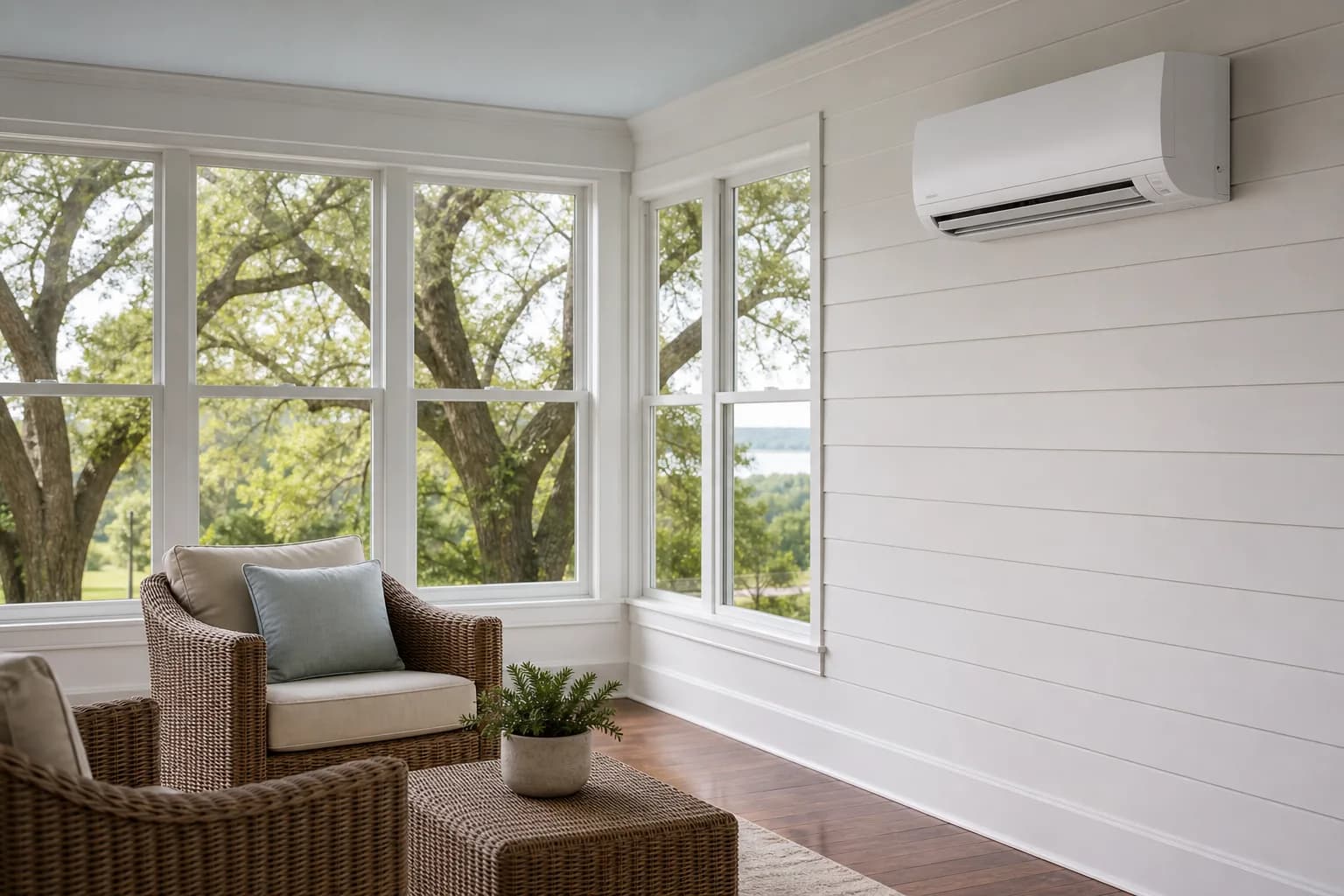
The Stapleton ductless conversation looks unlike most of the rest of the matrix because the housing-stock profile is genuinely its own. The 2022 ACS pegs the Stapleton CDP median build year at 2004, the youngest of any north-Baldwin community on our service map, and the dominant ductless scenarios here follow from that fact rather than from the supplement-to-aging-central pattern that Bay Minette sees on housing nearly thirty years older. The first and most common Stapleton scenario is the addition-or-conversion install: a homeowner who finished a screened back porch into a year-round sunroom that the original 2004 trunk-and-branch ductwork was never sized to extend into, a basement-conditioning project below an as-built crawl-or-basement envelope, a bonus area above a detached garage that got converted into a home office or guest suite a decade after the original build, or a primary-bedroom-suite addition appended after a family grew. The 2004 central ductwork is mechanically fine on the original envelope and does not need rebuilding; the addition simply needs its own conditioning layer that does not require running new supply trunk through finished walls. A single-zone ductless head on the addition envelope solves the problem cleanly and leaves the original system untouched.
The second recurring scenario is ag-property outbuilding conditioning. The rural-acreage geometry of the corridor produces a meaningful population of properties with agricultural outbuildings — a barn-and-tack-room combo where only the tack room needs conditioning while the barn aisle stays naturally ventilated, an equipment shed with a side office or breakroom, a pole barn with a small workshop section, or a converted detached garage on a multi-acre lot. These envelopes carry agricultural use patterns rather than commuter-corridor workshop patterns, and the install scope reflects that — livestock-area ventilation considerations adjacent to the conditioned zone, hay-storage humidity concerns next door to a tack-room indoor head, and sizing that depends heavily on actual envelope insulation rather than raw square footage. On under-insulated outbuilding envelopes we will recommend adding wall and ceiling insulation before sizing the equipment rather than oversizing the ductless and producing a clammy short-cycling system. The third scenario is dual-fuel hybridization on properties that already maintain a propane (LP) tank for the kitchen range, water heater, fireplace insert, or whole-house standby generator. That existing LP infrastructure changes the heating-mode arithmetic on a Stapleton ductless decision: an existing central LP-furnace-plus-AC pairing can keep serving the original envelope while a ductless head handles a new addition zone, or the homeowner can decommission an aging central system in favor of a multi-zone ductless layout backed by the existing LP furnace on the coldest mornings rather than spec'ing hyper-heat-rated outdoor units. Service-side patterns on installed Stapleton ductless equipment cluster around three recurring items: indoor-head condensate-pan biofilm from the long humid cooling season, outdoor inverter control-board damage from thunderstorm voltage transients on installs without surge protection at the disconnect, and multi-zone refrigerant-circuit leak diagnosis worked through the manufacturer's published leak-search protocol rather than general central-system habits.
- Newer housing stock predominates here. Builder-grade equipment commissioning issues and warranty-period failures are the typical calls.
- Long cooling season means compressors run heavy May through October. Annual maintenance pays for itself in compressor lifespan.
- Mild winters mean heat pumps cover the season comfortably without backup runtime in normal years. Cold-snap weeks expose undersized units.
Ductless Mini-Splits in Stapleton — the questions that come up.
- We finished a screened back porch into a year-round sunroom on our 2005-built Stapleton house and the central system can't keep up with it. Will a ductless mini-split actually solve the problem, and which approach makes sense?
- Addition and conversion conditioning is the most common Stapleton ductless scenario we walk through, and yes — a dedicated single-zone ductless head on the sunroom solves the comfort gap cleanly and is almost always the right answer rather than reworking the central ductwork. Your original 2004 supply trunk-and-branch system was sized for the house's original envelope; the branch runs were not designed to extend out into a porch-conversion addition added later, and pushing enough CFM through a new branch into the sunroom either does not work or robs capacity from rooms inside the original envelope that have always been comfortable. A purpose-sized ductless head on the sunroom takes the addition out of the central system's fight entirely, holds its own setpoint on its own thermostat, and lets the original system go back to doing only the work it was sized for. Sunroom envelopes have load characteristics worth measuring at the consult — large window areas (often three glass walls plus a glass ceiling on a true Florida-room conversion), heavy summer solar gain, and frequently less wall and ceiling insulation than the rest of the house. Typical sizing for a Stapleton sunroom of 200 to 400 square feet lands in the 12,000-to-18,000 BTU/hr range on a single indoor head paired to a small outdoor inverter, confirmed against measured envelope inputs at the in-home assessment rather than guessed from square footage alone.
- We have a barn with a small tack room on our rural Stapleton property, and the tack room is unusable in summer. Can a ductless mini-split condition it without ventilating the whole barn?
- Yes, and barn-tack-room conditioning is a genuinely common Stapleton ductless application on the rural-acreage parcels. The clean answer is to treat the tack room as its own conditioned envelope and leave the barn aisle, stalls, and feed area on their existing natural ventilation. The first step at the consult is confirming the tack-room wall and ceiling structure is sealed off from the rest of the barn — trying to condition an envelope open to the barn is losing arithmetic regardless of how much capacity gets thrown at it. Where the tack-room envelope needs upgrading before equipment goes in, we quote the envelope work and the equipment install separately. Once the envelope is right, sizing depends on dimensions, ceiling height, exterior-wall exposure, and how much equipment heat the room actually carries — a tack room used purely for storage has a far lower internal heat load than one set up as a small office or grooming-and-tack space. A typical Stapleton tack-room conversion of 120 to 250 square feet usually lands at 9,000 to 12,000 BTU/hr on a single head; a larger combined tack-and-office configuration sometimes warrants a two-zone outdoor inverter with separate heads. Outdoor unit placement on a barn install needs a thought-through location — clear of livestock-area traffic, clear of equipment movement paths, accessible for annual service, and on a level pad that does not flood-pond during heavy rain.
- Our Stapleton house already has a propane tank for the kitchen range and a fireplace insert. Does that change which kind of ductless heating equipment we should spec for the addition we're building?
- Yes, an existing LP tank on the property genuinely changes the heating-mode arithmetic compared to an all-electric house. You have two viable configurations for the addition's heating coverage. The first is a standalone variable-speed heat-pump ductless head sized for the addition's load, with the LP infrastructure left untouched — clean, single-system, no fuel switching to think about. The second is a dual-fuel approach where the ductless head handles cooling and shoulder-season heating while an existing or new LP furnace handles the deepest cold mornings — most cleanly executed when the addition is geometrically connectable to the existing central ductwork, or when the addition gets a small dedicated LP-furnace-and-blower as a backup layer below the ductless head. The second configuration is more equipment up front but on a winter with deep cold snaps it pulls the operating-cost arithmetic into a different place than auxiliary electric resistance strips would. We model the comparison against current Baldwin EMC residential rates and current LP delivery pricing at the in-home consult, because that LP-side input shifts season-to-season. For most Stapleton addition projects the standalone heat-pump ductless head is the right answer; the dual-fuel arithmetic becomes serious specifically when the addition is large enough that aux-strip duty during a deep freeze would noticeably swing the January electric bill.
- Our detached workshop on a Stapleton rural-acreage lot sits about a hundred feet from the main house. Is that distance a problem for ductless line-set routing, and where would the outdoor unit go?
- Distance gets engineered around rather than waved off. Standard residential ductless line sets come pre-charged at 15-to-50-foot lengths, and major-brand multi-zone outdoor inverter units publish maximum total piping lengths in the 100-to-200-foot range with documented capacity derate factors and additional refrigerant-charge requirements at the longer end. A hundred-foot main-house-to-workshop distance is workable but the install math differs meaningfully from a typical residential run. The design choice that drives everything else is whether to put the outdoor inverter at the main house with a long line set running to the workshop indoor head, or to put the outdoor unit directly outside the workshop and run longer electrical service out instead. We weigh both options against the existing electrical-service capacity at the workshop (often the deciding factor), the practical service-access geometry of each pad location, and the additional-refrigerant-charge requirements of the specific manufacturer lineup we're spec'ing. Outdoor refrigerant lines exposed to sun and weather over that distance need full-jacket UV-rated insulation rather than the standard pipe insulation that suffices on a short residential run. The whole configuration gets documented in writing on the proposal so the install crew works to a confirmed plan rather than improvising at the property.
- Air Solutions installs Carrier, Trane, Lennox, Goodman, Rheem, York, Bryant, and Amana on the central-system side. Which brand makes sense for a Stapleton ductless mini-split, and does Cool Club from day one make sense on a brand-new install?
- We're not an authorized dealer for any single manufacturer, which means our recommendation lands on what fits your specific project rather than on a dealer incentive. The ductless side of the mini-split market is somewhat its own brand landscape — Mitsubishi M-Series, Daikin, and Fujitsu lead the hyper-heat-rated multi-zone lineups that matter for the addition-and-outbuilding scenarios on the Stapleton corridor, alongside the major-brand ductless offerings from the central-system lineup we install. The selection conversation usually narrows on four practical considerations: the manufacturer's published heating-mode performance at lower outdoor temperatures (matters more on an under-insulated outbuilding than on a tight new sunroom), multi-zone outdoor inverter sizing flexibility if the project is likely to grow, parts-availability profile across the 10-to-12-year equipment lifespan, and any active manufacturer rebate or Baldwin EMC qualifying status that lowers the as-installed price. On the Cool Club question — yes, joining at install time is the right call on a brand-new ductless system for one specific reason: most quality ductless manufacturers require documented yearly professional maintenance as a condition of keeping the equipment warranty intact across the full parts term, and the bi-annual Cool Club cadence satisfies that requirement on the right schedule. The published member discounts on related repair and new-system line items are summarized in the service-area section above. No long-term contract and no cancellation penalty, so the value gets re-evaluated each year against the actual service history.
What ductless mini-splits looks like in this climate.
A ductless head added onto a Stapleton addition, conversion, or detached outbuilding lives a meaningfully different operating life than the central system serving the original 2004-vintage envelope next door. ERA5-Land at the Stapleton coordinate posts cooling-side runtime near 3,031 hours against a heating side near 1,154 hours over the 2023 baseline, which is a heavy inland dual-season load by Baldwin County standards. An inverter-driven mini-split sized correctly for the addition envelope spends most of that runtime modulating at part load — the long humid shoulder months where a single-stage central trying to extend into the addition would short-cycle through the smaller zone load, the deep-summer afternoons clearing 93°F where the variable-speed compressor holds dewpoint steady on the new envelope without overcooling the original house, and the cold-front weeks across December through February where the heat-pump cycle delivers real heating-mode capacity to the addition without leaning on the central system's auxiliary strips.
What the 1,154-hour heating side means specifically for a Stapleton ductless install is that the addition-envelope equipment is not a cooling-only afterthought. The corridor sits inland enough to lose any Mobile Bay thermal moderation and the January 2024 multi-night freeze put genuine cold-mode load on every heat-pump system across north Baldwin for several consecutive days. Entry-tier ductless lineups rated to roughly 5°F outdoor ambient handle a typical Stapleton winter morning without auxiliary draw on a properly-insulated addition envelope; the hyper-heat-rated lineups from Mitsubishi, Daikin, and Fujitsu earn their premium specifically on a poorly-insulated outbuilding conversion or a sunroom envelope with three-glass-wall exposure where the heating-mode capacity floor matters during the rare deep-cold week.
Storm and freeze events that shape ductless install and service decisions on Stapleton addresses.
- Jan 2024 — Multi-night sub-freezing stretch — heating-mode capacity test on addition envelopes: Three consecutive nights well below freezing with daytime highs barely clearing 40°F. For ductless equipment on Stapleton addresses the stretch tested how the equipment-tier decision plays out on an addition or outbuilding envelope specifically. Sunroom-conversion installs with three-glass-wall exposure and tack-room or detached-workshop installs on under-insulated envelopes pulled hard on the heating-mode capacity floor of standard-tier equipment during the coldest hours. Properly-spec'd hyper-heat-rated inverter units from Mitsubishi, Daikin, and Fujitsu held meaningful nameplate capacity through the week without auxiliary resistance heat; standard-tier installs in the same situations leaned on aux strips for hours and the January electric bill reflected it. Post-event install conversations through spring 2024 frequently anchored on whether to spec hyper-heat tier on the next ductless project.
- Sep 2020 — Hurricane Sally — north-Baldwin grid recovery and outdoor inverter electronics: Sally tracked east of Stapleton, but the outer wind field reached into the corridor and produced extended power outages along with repeated brown-out cycling on the Baldwin EMC north-county feeders during the multi-week restoration. Direct wind damage to outdoor ductless equipment was rare on the inland Stapleton parcels; the lasting effect was dirty-power exposure during grid recovery, where voltage transients absorbed by outdoor inverter control boards and reactor components surfaced months later as unexplained no-cool or no-heat tickets. A cluster of board-replacement calls landed across early and mid-2021 from Stapleton-area ductless systems that survived the storm only to fail during recovery. Surge protection at the outdoor disconnect is now a default line item on every Stapleton ductless install — the cost of the surge protector is a fraction of an inverter control board.
- Summer 2023 — Sustained above-90°F runs — part-load latent-removal on addition envelopes: An extended above-90°F stretch with July afternoon highs running near and above the 92.9°F seasonal mean. For Stapleton addresses already running ductless equipment on an addition or outbuilding envelope the period produced almost no service calls — the inverter compressors stayed in their efficient part-load operating band and the indoor heads held both setpoint and dewpoint cleanly. For addresses where the central system was trying to extend into a sunroom or porch conversion without a dedicated ductless head, the picture was different: indoor relative humidity drifting toward 60% in the addition zone even with the central thermostat reading on setpoint elsewhere, followed by a queue of consult calls asking whether a single-zone ductless head on the problem zone would close the gap. The part-load latent-removal performance of inverter ductless equipment is the most consistent driver of summer-end consultation volume on this housing stock.
What Stapleton customers can claim.
- Most Stapleton residential meters sit inside Baldwin EMC service territory without the multi-provider territorial complications that show up further south in the county. For most Stapleton ductless install consultations the rebate-eligibility question points to one utility rather than several, which keeps the program-side math straightforward. A small number of edge addresses may fall on a different provider, so we verify the actual provider on the homeowner's monthly electric bill before any rebate figure lands on a written quote.
- Baldwin EMC has historically run residential energy-efficiency incentive programs tied to qualifying high-efficiency heat-pump installations, and inverter-driven multi-zone ductless lineups typically score well against those efficiency thresholds because variable-capacity equipment pulls strong part-load efficiency numbers. Specific qualifying-equipment lists and rebate dollar amounts move on the cooperative's annual cycle, so before any rebate figure goes onto a written quote we pull the current program sheet directly rather than carry a stale figure into the project budget. Where a manufacturer is mid-promotion on a specific ductless model, those rebates get applied to the quote at signing rather than handed off to the homeowner as a reimbursement chase after the install lands.
- The federal 25C credit expired December 31, 2025 and is not available on ductless installations placed in service in 2026 or later. We leave the commissioning records and equipment specification sheets with the homeowner — ask your accountant about 2025 return eligibility if a qualifying system was placed in service before that date.
- Mini-split service work — drain-line clearing, board-level electronics replacement on an outdoor inverter, refrigerant leak repair, indoor-head fan-wheel cleaning, outdoor-coil rinse — does not generally qualify for utility rebates regardless of provider. Utility incentive pathways apply to qualifying-tier new installations only. For service-side line items the relevant member benefit is Cool Club, which covers the bi-annual professional visits and member discounts on the service work itself.
Every Stapleton neighborhood, every zip.
A multi-zone ductless install at a Stapleton address breaks naturally across three phases — a pre-install assessment visit to confirm head placement and line-set routing, the install day (or two-day stretch on a larger configuration) for the refrigerant and electrical work, and a commissioning follow-up after the system has logged a couple of weeks of part-load runtime. The dispatch math on the US-31 corridor lets each of those phases happen at the right cadence rather than getting compressed to amortize a long drive: the OSRM routing posts the trip from our Daphne shop at 15.7 miles and roughly 25 minutes via the US-31 spine, with the I-65 approach as one realistic alternative for parcels closer to the interchange. That travel slice is small enough that a morning pre-install consult does not eat a full half-day for either the homeowner or the crew, and the commissioning follow-up visit a few weeks later schedules into a regular north-county route day without requiring a dedicated trip up the corridor. Coverage runs across the full 36578 ZIP — the US-31 frontage homes, the Downtown Stapleton residential pockets, the rural-acreage parcels east and west of the corridor where the ag-property outbuilding work tends to land, and the subdivisions on the I-65 approach where the interchange drops south toward Spanish Fort.
To start the conversation, the line at (251) 300-9817 reaches us around the clock for ductless install inquiries and for the service questions that come up after commissioning — drain-line concerns on an indoor head, a winter-mode reversing-valve check, a remote-control pairing question — with live pickup during business hours and a callback to any after-hours ring going out on the next available phone touch. Cool Club is the residential maintenance membership, and on a freshly-commissioned Stapleton ductless system the case for joining at install time rests on a specific manufacturer-warranty consideration: most quality ductless manufacturers make documented yearly professional maintenance a precondition for keeping the full parts-warranty term valid, and a bi-annual visit cadence on the new indoor head and outdoor inverter unit satisfies that documentation requirement while keeping the indoor-head fan wheel, the condensate pan, and the outdoor coil on the right cleaning schedule for the long Stapleton cooling season. Member benefits include 15% off all AC repairs and 5% off new systems on any related line items across the membership year, with no long-term contract attached.
- Downtown Stapleton
- the US-31 corridor
- the I-65 approach
- rural Stapleton acreage
Ductless Mini-Splits Coverage Map — Stapleton, Alabama
Centered near Stapleton for orientation. Air Solutions Heating & Cooling provides ductless mini-splits throughout every Stapleton neighborhood and zip code, plus the surrounding Baldwin County area. Same crew, same number — we travel the whole county.
353+ Five-Star Reviews. And Counting.
“Jacob was friendly, professional and prompt.”
“Jacob was absolutely wonderful. Definitely would recommend him and this company!!”
“⭐⭐⭐⭐⭐ **Outstanding Service from Air Solutions and Jesse!** I can't say enough good things about my experience with **Air Solutions**, especially their technician **Jesse**. After dealing with my 10-year-old HVAC system, I wanted someone who would actually take the time to diagnose and properly service the system rather than simply recommend replacing it. Jesse exceeded my expectations. He was…”
Schedule Ductless Mini-Splits in Stapleton.
Zone cooling for additions, garages, sunrooms, historic homes. Same-day appointments most weekdays in Stapleton and surrounding Baldwin County. Tell us when works for you — we'll confirm by phone during weekday office hours (8 AM-4 PM).
Need someone right now? Call (251) 300-9817 — our 24/7 emergency line is answered live when we can and returned quickly when we can't.
Ductless Mini-Splits in Stapleton — FAQs
When does a ductless mini-split make sense for a Baldwin County home?
Five common Baldwin County scenarios: (1) garage conversions, sunrooms, or additions with no existing ductwork; (2) detached structures like workshops or pool houses; (3) historic homes (Olde Towne Daphne, downtown Fairhope, Magnolia Springs cottages) where retrofitting central ductwork would be invasive; (4) one specific room that won't cool properly with central AC; (5) vacation rentals with variable occupancy where per-zone control matters. For most other situations, traditional central air is more cost-effective.How much do mini-splits cost installed in Baldwin County?
Single-zone mini-splits run $2,500-$7,500 installed depending on brand and indoor unit type (wall-mounted is cheapest, ceiling cassette adds 30-50%). Multi-zone systems range from $6,500 (2-zone) to $25,000+ (5+ zones). Mitsubishi M-Series and Daikin mid-tier units offer the best value for Baldwin County applications. Coastal-grade outdoor units add 10-15% but extend lifespan in salt air.Did mini-splits qualify for the 25C tax credit?
The federal 25C credit expired December 31, 2025 and is no longer available for systems installed in 2026 or later. Qualifying mini-split systems installed on or before December 31, 2025 may still be claimable on a 2025 federal return — verify with a CPA. For new installs, ask about Alabama Power and manufacturer rebate programs that remain active.Do you service all of Stapleton, AL?
Yes — Air Solutions Heating & Cooling covers every neighborhood and zip code in Stapleton, Alabama — including Downtown Stapleton, the US-31 corridor, the I-65 approach, plus the surrounding subdivisions and rural roads. We handle AC repair, AC installation, AC maintenance, emergency HVAC, and commercial HVAC. Standard service hours weekdays, 24/7 emergency response, and same-day appointments most of the year. Call (251) 300-9817 to schedule.What HVAC issues are most common in Stapleton?
Homes around US-31 corridor most commonly call us for refrigerant leaks (often salt-air or coil corrosion related on the Gulf Coast), undersized air conditioning systems struggling with Baldwin County summer humidity, and capacitor failures during peak load between June and September. A Cool Club bi-annual maintenance plan catches most of these issues before they cause a breakdown.
Ductless Mini-Splits Near Stapleton.
Right at the Stapleton city limit? We service the surrounding Baldwin County communities on the same routes — same crew, same response times.
Related HVAC Guides.
Long-form articles about ductless mini-splits and Baldwin County HVAC, with practical advice from our team.
Other services in Stapleton & this service across Baldwin County.
- All HVAC services in Stapleton, AL
- Ductless Mini-Splits across Baldwin County
- AC Repair in Stapleton
- AC Installation in Stapleton
- AC Maintenance in Stapleton
- Commercial HVAC in Stapleton
- Emergency HVAC in Stapleton
- Heating Repair in Stapleton
- Heat Pump Services in Stapleton
- Indoor Air Quality in Stapleton
- Heating Installation in Stapleton
Ductless Mini-Splits in Stapleton — Schedule Today.
Same-day appointments most weekdays. Cool Club members get prioritized scheduling.