
Mini-Splits for Bay Minette Shops, Additions, and Acreage Homes
North Baldwin acreage means detached shops, barn offices, and additions where ductwork isn't practical. Why a heat-pump mini-split cools and heats them in Bay Minette, AL.

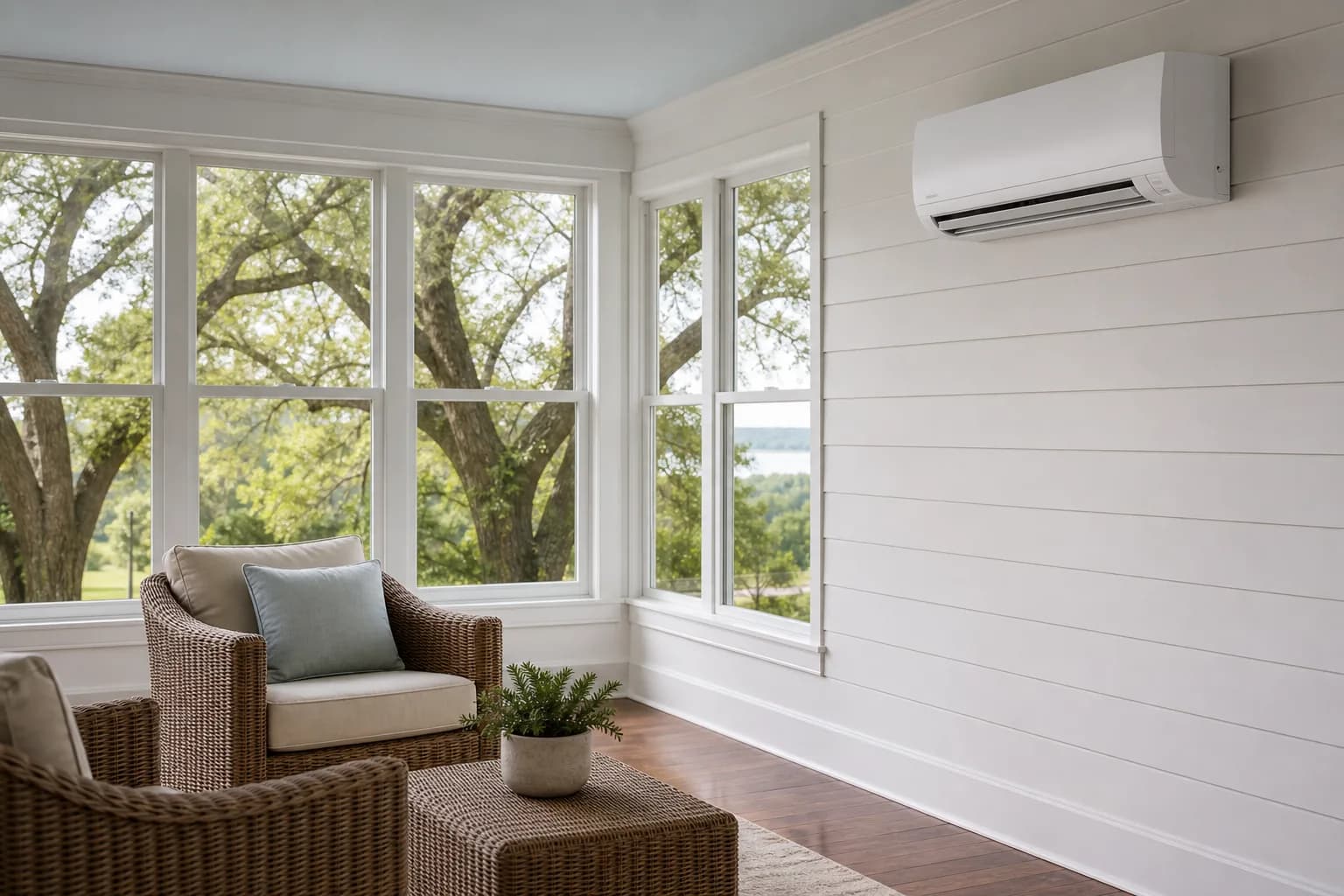
Out around Bay Minette and the north end of the county, people have room to spread out — and they use it. A metal shop for the equipment and the projects. A barn with an office corner partitioned off. A pole building that became a workspace. An addition tacked onto the back of an acreage home years after it went up. These are the spaces that make rural property worth having, right up until you try to make them comfortable in August or on a cold January morning.
The wall they all hit is the same: the house's central system was never meant to reach a detached building, and running ductwork out across the yard to a separate structure is either impossible or absurdly expensive. That's the exact job a ductless mini-split was designed for, and on the wooded lots out toward the Tensaw River and along the Highway 31 corridor I recommend them constantly — partly because here, the heating side matters as much as the cooling.
Why you can't just stretch the house system
A central AC is built as one closed package: a set amount of cooling pushed through a fixed run of ducts to serve a fixed square footage. It isn't a spigot you can tap. Run a long duct out to a detached shop and you either rob the rooms the system was sized for or lose so much conditioned air over the distance that almost nothing useful arrives. And when the space is a separate building across the driveway, there's no practical duct path at all — you'd be trenching insulated ductwork underground or running it overhead, neither of which makes sense.
So people improvise. A window unit that's loud and short-lived. A propane heater that's a real fire risk in a shop full of sawdust and solvents. A kerosene heater that fogs the windows and smells. None of it is a fix, which is why so many of these buildings just sit too hot half the year and too cold the other half.
What a mini-split does for an outbuilding
A ductless mini-split is its own complete system — an outdoor condenser, one or more indoor heads, and a slim refrigerant line set connecting them through a hole about three inches across. It doesn't touch the house's ductwork and it doesn't share its capacity. You mount it on the shop, the barn office, or the addition, and it conditions that space independently.
For a detached structure on acreage, that independence is everything. The shop gets its own equipment sized for its own load, on its own thermostat, running only when you're out there working. No re-engineering the house system, no impossible duct run across the yard.
The heating side north-county homeowners overlook
This is where Bay Minette differs from the beach conversations. Up here, winter mornings actually get cold, and an unheated shop or barn office is miserable from December through February. The good news is that nearly every residential mini-split we install is a heat pump — meaning the same equipment that cools in summer reverses and heats in winter.
For our mild-winter climate, that's a genuinely good match. A heat-pump mini-split pulls heat from the outside air even when it's chilly and moves it inside efficiently, and our winters rarely get cold enough or long enough to push a properly sized unit past its limits. For a barn office you want to use year-round or a shop you'd like to wrench in come January, you get heating and cooling from one quiet system — no separate furnace, no fuel-burning heater sitting in a building full of flammables.
Matching the system to the space
Sizing an outbuilding is its own animal, and it's where cheap installs go wrong. A bare metal shop, an insulated pole building, and a finished barn office of the same square footage carry wildly different loads. Insulation level, ceiling height, how much glass and how many big doors, sun exposure, and whether the slab is conditioned all change the math.
We run a real load calculation for the space instead of guessing off the footprint, because the consequences of getting it wrong are concrete:
- Too small and the unit runs flat-out and still loses on a hot afternoon or a cold snap.
- Too big and it cools quickly, shuts off, and never runs long enough to pull humidity out — leaving a clammy shop and a system short-cycling itself toward early wear.
For a multi-zone setup — say the shop plus a barn office, or a home addition plus a detached studio — one outdoor unit can feed several heads, and we check that it can carry every zone running at once. We also spec for the environment: dust in a working shop means filter access matters, and the outdoor unit needs clearance from the brush and tall grass that come with acreage.
What it costs — and how we quote it
A single head in an insulated barn office and a multi-zone system covering a shop plus an addition are very different projects, so I won't throw out a number that turns out wrong. We come look at the building, run the load math, factor in the heating demand, and put the price in writing before any work starts. The estimate is free, a second opinion on another quote is free, and financing is available (subject to credit approval) if the timing matters.
Ready to make the shop usable year-round in Bay Minette?
Air Solutions Heating & Cooling designs and installs heat-pump mini-splits for shops, barn offices, and acreage additions across Bay Minette and north Baldwin County. Family-run, founded in Daphne, licensed AL#23194, BBB A-rated.
- Schedule a ductless consult — free in-home estimate
- Call (251) 300-9817 — talk through your shop or addition
- Ductless mini-split services — full overview
Related reading
- Ductless mini-splits for Perdido acreage additions — the same outbuilding logic on another stretch of inland acreage
- Mini-split zoning for Foley bonus rooms and garages — when the hot space is attached, like a room over the garage
- Multi-zone mini-splits for Silverhill additions and garages — running several heads off one condenser
Related resources
- Ductless mini-splits in Bay Minette — city-specific service page
- All HVAC services in Bay Minette — every service locally
- Cool Club membership — seasonal tune-ups and priority scheduling