
Section 179 HVAC Deduction Guide for Baldwin County Businesses
How Baldwin County businesses can use the Section 179 deduction on commercial HVAC installations and replacements.

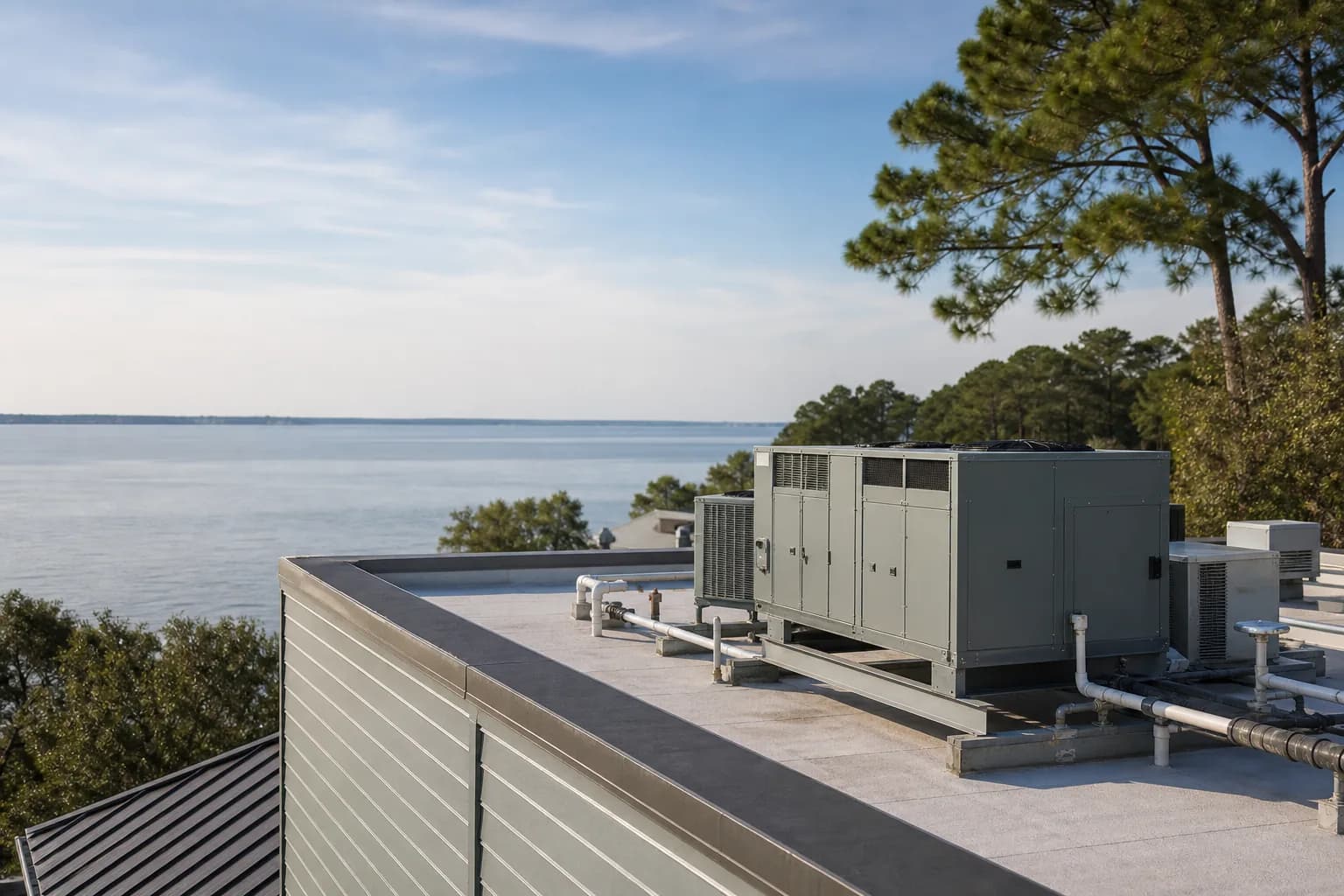
For Baldwin County businesses replacing commercial HVAC — a Daphne restaurant on the Hwy 181 corridor, a retail strip near the Historic Malbis interchange, an office park up the bluffs from Mobile Bay — IRS Section 179 changed the math when it was expanded in 2018 to cover commercial HVAC. Before that, this equipment had to be depreciated over 39 years, so a restaurant replacing its rooftop units could deduct only a fraction of the cost each year. Section 179 now lets qualifying commercial HVAC be expensed in full the year it's placed in service, up to the annual IRS cap.
This post covers what qualifies, how the deduction works in practice, and the timing considerations that make Section 179 most valuable for Baldwin County businesses. This is general guidance — every specific situation should be confirmed with a CPA or qualified tax preparer.
What Section 179 covers for HVAC
Section 179 of the IRS code lets a business deduct the full purchase price of qualifying equipment placed in service during the tax year, up to the current-year IRS cap — verify with your tax preparer.
For HVAC specifically, the 2018 expansion (TCJA) added "qualified improvement property" — including HVAC components placed in service in nonresidential buildings already in use — to the eligible list. Before this change, commercial HVAC was capitalized and depreciated over the 39-year nonresidential real property schedule. Now it can be fully expensed in the year of install, subject to the annual cap and other limits.
What qualifies:
- Replacement HVAC equipment in an existing commercial building (rooftop units, split systems, ductless systems, package units)
- HVAC equipment installed as part of a building renovation or improvement
- Heating, ventilation, and air conditioning components and controls
- Some related electrical and ductwork modifications tied to the HVAC install
What doesn't qualify under Section 179:
- HVAC installed as part of new construction (different depreciation schedule applies)
- Equipment installed in residential property (Section 179 is for business-use property; rental properties have separate rules)
- Equipment placed in service before the expansion (pre-2018 installs operate under old depreciation rules)
What qualifies in Baldwin County
For a Baldwin County business, the practical scope is broad. Section 179 typically covers:
Restaurants replacing rooftop units, walk-in cooler/freezer compressors (with caveats), or kitchen exhaust systems tied to HVAC. Restaurants often have the cleanest Section 179 case because the equipment is unambiguously business-use property.
Vacation rental operators — but only on properties classified as commercial real estate or short-term rental businesses with active management. Personal vacation homes don't qualify. The line between "vacation rental" and "commercial property" depends on management structure, time of use, and tax classification. Your CPA can confirm.
Retail replacing rooftop units or split systems serving the retail space — common for the shopping centers clustered around the Historic Malbis interchange and the Hwy 181 commercial strip in Daphne.
Property managers handling commercial buildings — multi-tenant office, mixed-use, retail-with-residential-above — where the HVAC serves commercial portions of the building.
Industrial / warehouse operations replacing or adding HVAC for office portions, conditioned-storage areas, or specific process-cooling equipment.
What's most often disputed at audit:
- HVAC installed in mixed-use property (commercial portion qualifies, residential portion doesn't)
- Rental property with insufficient business activity to qualify as commercial
- Improvements that are part of larger building renovations where the HVAC scope is bundled in
Documentation matters here. The contractor invoice should break out the HVAC scope clearly so the qualifying portion is unambiguous.
What happened to the 25C residential credit
If you've read older guidance, you may have seen Section 179 paired with the federal 25C heat pump tax credit. That pairing no longer exists going forward: the 25C Energy Efficient Home Improvement Credit expired on December 31, 2025 under the 2025 federal budget law. It is not available for any 2026-or-later install. The only remaining use is a qualifying residential system placed in service on or before 12/31/2025, which can still be claimed on the 2025 federal return (filed in 2026). For a current install, 25C is off the table.
Section 179 is unaffected by that change — it's a separate provision for business-use property and remains in force. Worth being clear on the difference between the two:
- 25C was a credit (reduced tax owed dollar-for-dollar) for primary residences. It has expired for new installs.
- Section 179 is a deduction (reduces taxable income) for commercial property, and it continues.
So the overlap case that used to apply to owner-occupied mixed-use buildings — Section 179 on the commercial-portion HVAC plus 25C on a separate residential-portion install — only held for residential work completed by the end of 2025. For commercial HVAC placed in service in 2026, Section 179 still stands on its own; the residential credit no longer rides alongside it.
Another federal incentive worth knowing about for commercial HVAC: Section 179D (Energy Efficient Commercial Building Deduction), which is separate from Section 179 and applies specifically to energy-efficient commercial property improvements meeting defined efficiency thresholds. 179D and Section 179 can stack in some cases. Your CPA can confirm. On the utility side, the live programs that may still apply to a 2026 install are local — we keep a running list in HVAC rebates and incentives for Baldwin County homeowners.
End-of-year timing
Section 179 applies to equipment "placed in service" during the tax year. That language matters:
- Equipment delivered but not yet installed at year-end does NOT qualify for that tax year
- Equipment installed and operational by December 31 DOES qualify for that tax year
- Contracts signed in December for January installs apply to the new tax year
For Baldwin County commercial customers running calendar-year tax filings, this creates a real Q4 incentive: equipment that needs replacement and is scheduled to install January-March could be pulled forward into December to capture the Section 179 deduction in the current tax year. The math depends on:
- Your projected tax liability for the current year
- Whether deferring the deduction to next year aligns with anticipated higher income
- Whether the install can realistically complete by year-end given crew availability and equipment delivery windows
For Baldwin County businesses considering Section 179 timing, the deadline-driven move is to:
- Decide on the install during Q3 (July-September)
- Sign the contract and order equipment in October
- Schedule installation for November or early December
- Confirm "placed in service" date is documented on the invoice and inspection records
Pushing the decision into late December typically creates timeline pressure that risks missing the year-end window. The commercial HVAC trade gets booked solid in the second half of December every year.
What documentation does the IRS want at audit?
A clean Section 179 claim has:
- Contract or invoice showing the equipment cost, scope of work, and date placed in service
- Equipment specifications confirming it's qualifying HVAC property (model numbers, AHRI matching reference if applicable)
- Building classification documentation if mixed-use or rental property
- Final inspection records showing the install passed mechanical inspection in the tax year claimed
- Manufacturer warranty registration confirming "placed in service" date
That inspection record is also a local permitting requirement, not just a tax document — we explain the Baldwin County process in do you need a permit to replace your AC in Baldwin County.
Keep all of this in your tax file for the standard IRS look-back window (typically 3-7 years depending on the situation).
Annual limits and phaseouts
Section 179 has two limits worth knowing:
- Annual deduction cap. The maximum total Section 179 deduction across all qualifying property in a tax year. The cap is set by Congress and indexed for inflation; verify the current-year cap with your tax preparer.
- Phase-out threshold. If your total qualifying equipment purchases in the tax year exceed a phaseout threshold (also set annually), the Section 179 deduction begins to reduce dollar-for-dollar. Large purchases can phase out the deduction entirely.
For most small-to-mid Baldwin County commercial operations replacing one or two HVAC systems per year, the cap and phaseout don't apply — the deduction is fully available. For larger property portfolios or major capital years, the phaseout math becomes relevant and the CPA conversation matters more.
Ready for a commercial HVAC quote?
Air Solutions Heating & Cooling provides commercial HVAC installation and replacement quotes for Baldwin County businesses with Section 179-formatted documentation. For a sense of equipment pricing before you budget the deduction, see what AC replacement costs in Baldwin County in 2026. Family-run, founded in Daphne, licensed AL#23194.
- Get a Commercial Quote — walkthrough plus written proposal
- Commercial HVAC services — full overview
- Call (251) 300-9817 — the office answers during business hours; after hours, our 24/7 emergency dispatch routes your call