
Heat Pump or Gas Furnace in Foley? Sorting the 2026 Tradeoffs
In Foley's fast-growing all-electric subdivisions, the heat-pump-versus-gas-furnace question often answers itself. Here are the real tradeoffs.

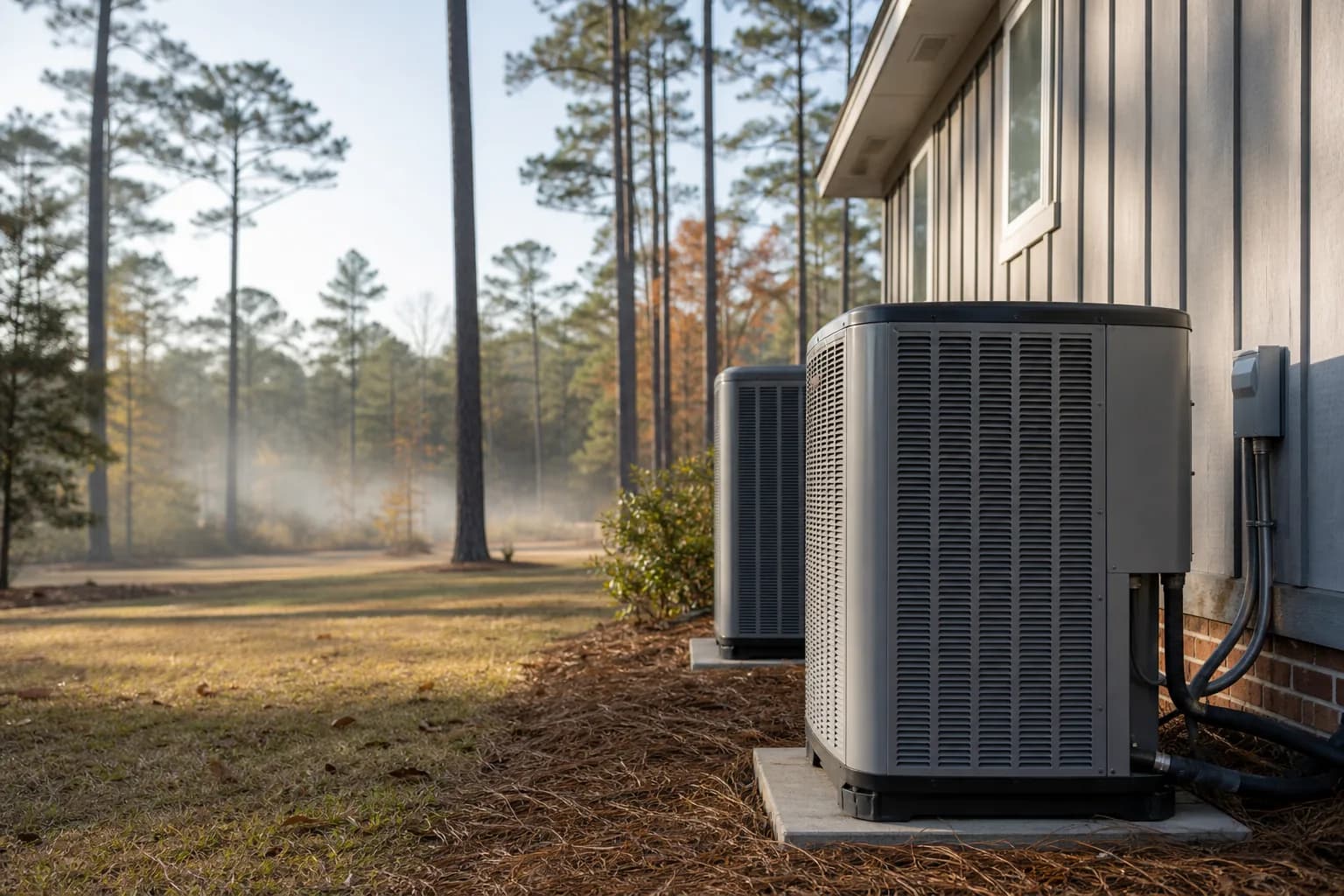
Here is something that surprises a lot of folks shopping for heating in Foley's newer neighborhoods: before you can even have the heat-pump-versus-gas-furnace debate, you have to check whether you have a gas line at all. A big share of the subdivisions that have gone up around OWA and out along the Hwy 59 corridor — Glenlakes, Magnolia Place, the Graham Creek Estates side of town — are built all-electric. No meter, no service line. For those Foley homes the debate is mostly settled before it starts, but it is worth understanding either way.
First, do you even have gas service?
This is the fork that decides most Foley installs.
If your home is all-electric — and a lot of the recent builds are — putting in a gas furnace means paying to bring gas to the property before you have heated a single room. That is a meaningful add-on for a system that, in our climate, a heat pump handles comfortably. In that situation a heat pump is not just the easier choice, it is usually the obvious one.
If you already have gas running to a water heater, range, or dryer, the calculus opens up. The cost of feeding one more appliance off an existing line is far smaller than running a brand-new line, so a gas furnace stays on the table as a real option.
What you are actually choosing between
A quick refresher, because the choice often gets made on half-information.
A heat pump is one outdoor unit that both cools in summer and heats in winter; it just runs the refrigerant cycle backward when you need heat, pulling warmth out of the outside air and moving it indoors. It runs on electricity, full stop.
A gas furnace only handles heating. You still need a separate AC for our long cooling season. The furnace burns gas, a heat exchanger transfers that warmth to your air, and a blower pushes it through the ducts.
So a heat pump is one appliance doing two jobs; a furnace-plus-AC setup is two appliances splitting the year.
Why our climate leans heat pump
Foley winters are short and mild. The cold-weather scenario where heat pumps struggle — sustained, deep sub-freezing temperatures for days on end — basically does not happen on this stretch of the Gulf Coast. We get a handful of genuinely cold nights a year and a long, demanding cooling season. That profile is exactly where a heat pump shines, because most of the time it is operating in its efficient range, and for the rare hard freeze, auxiliary electric heat strips carry the load. If you're weighing whether the technology fits the area at all, our Eastern Shore take on heat pumps lays out the same climate logic.
Put plainly: the conditions that make a furnace worth its extra complication in, say, the Midwest just are not Foley's conditions.
Comfort: the honest comparison
This is where personal preference earns a vote.
| Heat pump | Gas furnace | |
|---|---|---|
| Heat delivery | Steady, even, runs longer at lower output | Hotter bursts, quicker recovery from a cold start |
| Air at the register | Warm, closer to body temperature | Noticeably hotter to the hand |
| Summer humidity control | Strong, especially variable-speed models | Handled by the separate AC |
| Combustion concerns | None — fully electric | Requires combustion air and venting |
Some people love the hot blast of a gas register on a cold morning. Others prefer a heat pump's longer, gentler cycles and the steadier room temperature that comes with them. Neither is wrong. In our humid summers, the heat pump's dehumidification is a genuine point in its favor, and there is no combustion byproduct to vent.
Where a gas furnace still earns its keep in Foley
I am not anti-gas. A furnace can be the right answer when:
- You already have gas service feeding other appliances, so adding the furnace is incremental.
- You genuinely prefer that hot-register feel and want it for the coldest stretch of the year.
- You are looking at a dual-fuel setup — a heat pump paired with a gas furnace — where the heat pump does the everyday work and the furnace only steps in on the coldest nights. That can be a nice fit for a long-term Foley home that already has gas, though it is a more complex system to buy and maintain.
For most Foley homes without existing gas, though, a straight heat pump is the simpler and more sensible path.
Lifespan and upkeep, in plain terms
A gas furnace tends to outlast a heat pump's outdoor unit, because the furnace sits dry and indoors and only works in winter, while the heat pump runs hard in both seasons and lives outside in the weather. But here is the catch: if you go furnace-plus-AC, that AC unit wears on roughly the same timeline a heat pump would, so you are eventually replacing equipment either way. With a heat pump you maintain and replace one outdoor system; with furnace-plus-AC you are servicing two appliances and adding a combustion safety check the heat-pump owner never needs. I will not put a dollar figure on that here — it depends on your equipment and how hard you run it — but more appliances generally means more to maintain.
A note on coastal-grade equipment
Foley sits inland of the immediate beachfront, but it is still close enough to the Gulf — and to the Bon Secour and Wolf Bay water on the south side of town — that salt-influenced air is a factor for outdoor equipment. Whichever direction you go, ask about corrosion-resistant, coastal-grade specifications for anything living outside. It is worth the conversation here. Our guide to how far from Mobile Bay salt-air corrosion really matters puts some honest boundaries on it.
Federal tax credits
Here's the part that changed: the federal 25C tax credit that high-efficiency heat pumps — and, to a lesser degree, qualifying gas furnaces — used to earn expired after December 31, 2025. A 2026 install no longer qualifies for it. The only lingering use is for a system placed in service on or before that date, which can still be claimed on the 2025 return. Where there's still room to save is local: utility programs like Alabama Power and TVA EnergyRight rotate efficiency incentives, so check what's current for your address. This is general guidance, not tax advice, so run the specifics by a CPA. We still provide the AHRI certification paperwork at install for warranty registration and your own records.
Questions to ask any installer
- "Do I have gas service, and what would it cost to add if I do not?"
- "What are the SEER2 and HSPF2 ratings on what you are quoting?"
- "Are you running a Manual J load calculation to size it?"
- "What coastal-grade options do you offer for the outdoor unit?"
- "Will I get AHRI documentation for the warranty registration and my records?"
The Foley bottom line
For the many Foley homes built all-electric, a heat pump is usually the clear and uncomplicated choice — one system, well-matched to a mild-winter climate. If you already have gas, a furnace or a dual-fuel system is worth weighing on comfort preference and your existing setup. Either way, the decision should start with measuring your actual house, not with a number off a page.
Ready to talk it through in Foley?
Air Solutions Heating & Cooling quotes heat pumps, gas furnaces, and dual-fuel systems with a Manual J load calculation on every job. Family-run, founded in Daphne, licensed AL#23194.
- Call (251) 300-9817 to talk options
- Schedule a consultation for your home
- Heat Pump Services — the full overview
Related resources
- Heat Pump Services in Foley — local service page
- All HVAC services in Foley — everything we cover nearby
- HVAC Financing — payment options