
AC Unit Lifespan on the Gulf Coast
How long AC units actually last on the Gulf Coast, what salt air does to them, and how Baldwin County homeowners extend service life.
Manufacturer literature says residential AC equipment lasts 12-15 years. On the Gulf Coast that range is optimistic for some homes and conservative for others, and which end you land on is mostly determined by three things you can actually control: distance from the water, maintenance discipline, and install quality. Here's what's true about AC lifespan on the Baldwin County coast — and what extends it.
What "average lifespan" actually means
Carrier, Trane, Lennox, Goodman, and the rest publish "expected useful life" figures of 12-15 years for residential central AC, 15-18 years for premium variable-speed equipment. Those numbers assume average operating conditions — moderate climate, average maintenance, no extreme corrosive exposure.
Baldwin County is none of those things. Our cooling season runs roughly nine months a year (early March through late November), so the equipment accumulates close to twice the running hours that a Midwest home would in the same calendar period. Add salt-air corrosion at the coast and lifespan splits by location.
In our service experience across Baldwin County, the practical ranges look like:
- Inland (Bay Minette, Robertsdale, Stockton): 12-16 years on standard equipment, 15-20 years on premium with bi-annual maintenance — close to manufacturer numbers.
- Eastern Shore (Daphne, Fairhope, Spanish Fort): 11-15 years on standard, 14-18 years on premium. Slightly shorter than inland due to bay-air moisture, but salt exposure is modest.
- Gulf coast (Gulf Shores, Orange Beach, Fort Morgan): 8-12 years on standard equipment, 12-15 years on coastal-grade equipment with disciplined maintenance. Salt-air corrosion is the dominant variable here, and exposure varies even within Gulf Shores — a home set back in Craft Farms or Gulf Shores Golf Club Estates sees a gentler timeline than a place taking direct salt spray near Beach Boulevard or the dunes by Gulf State Park.
The standard manufacturer warranty (10-year compressor / 10-year parts when registered) covers most of the inland service life. On Gulf-coast properties the warranty often outlasts the corrosion-driven failure window — which is why coastal-grade equipment matters more than it does five miles inland.
Salt air's three-year, five-year, seven-year corrosion timeline
Salt air doesn't sand-blast equipment. The corrosion mechanism is chemical. Salt particles deposit on aluminum coil fins and steel cabinet components. In Gulf-Coast humidity those deposits stay damp, becoming a continuous low-grade electrolyte sitting on the metal — and that's what corrodes. (How far inland this actually matters is its own question — we break it down in how far from Mobile Bay corrosion really reaches.)
What corrodes first, in roughly the order it shows up on a non-coastal-grade system at the beach:
- Year 2-3: Surface rust on cabinet screws and disconnect-box hardware. Cosmetic at first; structural later.
- Year 3-5: Aluminum coil fins begin pitting visibly. Refrigerant pressures may drift slightly out of spec. The coil isn't leaking yet, but its surface area is shrinking.
- Year 5-7: Cabinet panels rust through at the seams. Water intrusion accelerates internal corrosion. Refrigerant line insulation cracks and exposes copper. Electrical disconnect connections oxidize and run hot.
- Year 7-10: Coil pitting progresses to refrigerant leaks. Compressor strain from running on low charge becomes the next failure mode. Cabinet structure may no longer support the equipment properly.
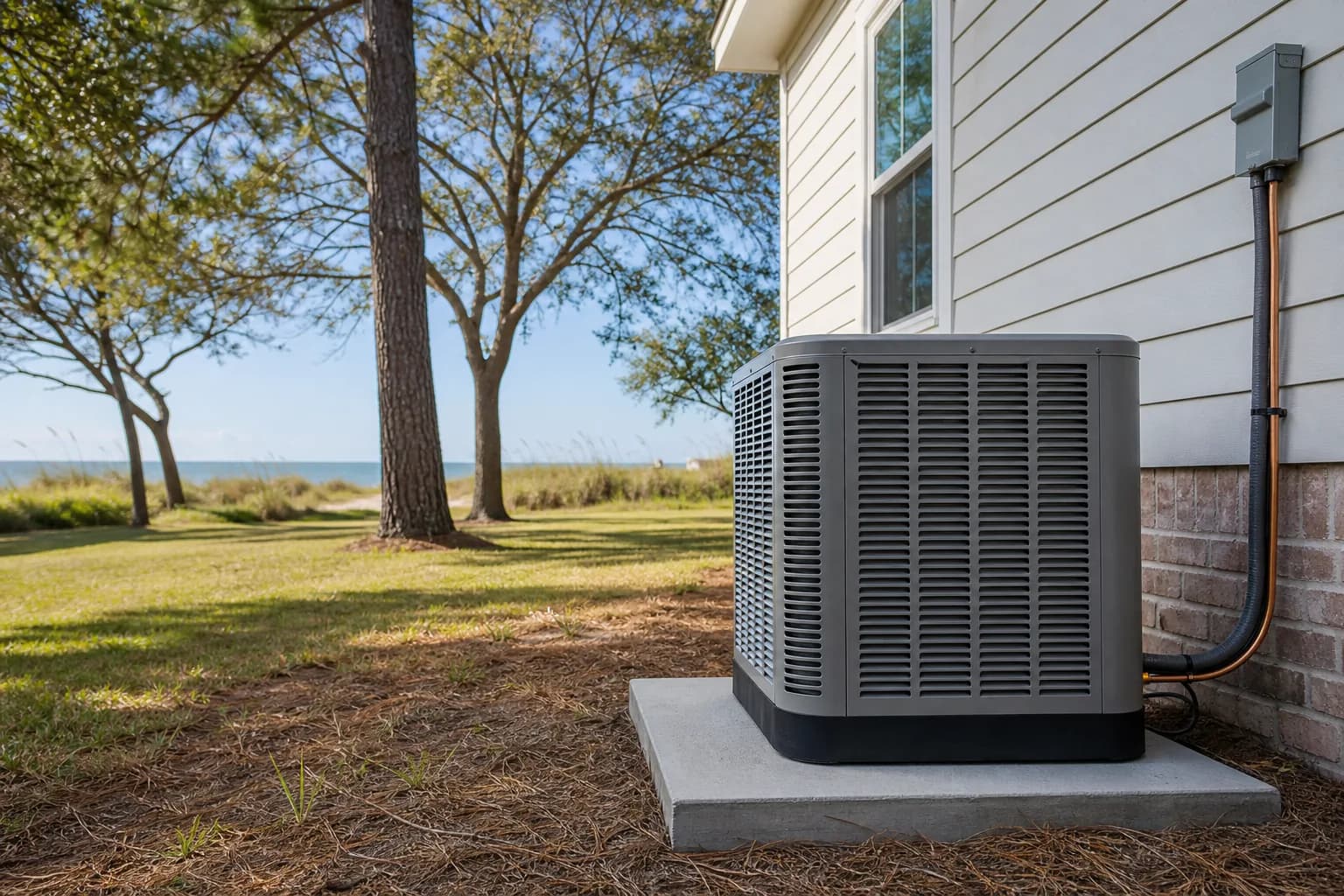
Coastal-grade equipment addresses these with E-coated coils (epoxy coating protects the aluminum from salt), stainless or galvanized hardware, and corrosion-resistant cabinet treatments. The upcharge over standard equipment is modest relative to the lifespan benefit at the coast.
How much does distance from the water really change lifespan?
More than almost any other factor at the beach. Salt deposition drops off sharply as you move back from the surf, so two identical units installed the same year can age very differently depending on the lot. A condo or cottage taking direct Gulf spray out toward The Peninsula or Kiva Dunes will show cabinet rust and fin pitting years ahead of a comparable system tucked into an interior lot in Craft Farms North a mile back. That's why the same equipment carries different replacement expectations across Gulf Shores, and why the closer you are to the water, the more a coastal-grade unit and a monthly fresh-water rinse earn their keep. Distance you can't change — but the equipment grade and the rinse habit are both within your control.
Coastal-grade equipment options
Most major manufacturers offer a coastal variant of their core lineup. The features that actually matter:
- E-coated outdoor coil. The single most important coastal upgrade. Adds 3-5 years to coil life.
- Stainless steel cabinet hardware. Screws, hinges, fasteners. Prevents the "rust dripping down the cabinet" stage.
- Corrosion-resistant cabinet finish. Powder coats and zinc-rich primers slow the panel-rusting timeline.
- Sealed electrical connections. Conformal coating on circuit boards, weatherproof disconnects.
Worth getting at install if you're within ~1 mile of the Gulf or directly on Mobile Bay. Probably not necessary further inland — the bay-air corrosion timeline is much slower than ocean exposure.
One note on incentives, since older articles still raise it: the federal 25C heat-pump tax credit ended December 31, 2025 and no longer applies to a 2026 or later install — coastal-grade or otherwise. The only remaining use is a system placed in service on or before that date, which can still be claimed on the 2025 return; confirm your situation with a CPA. Choosing coastal-grade hardware never affected eligibility either way.
Maintenance that actually extends life
Independent of equipment grade or distance from water, the largest controllable variable in AC lifespan is whether the system gets professional maintenance twice a year. Maintained equipment routinely outlasts unmaintained equipment by 4-7 years across all Baldwin County zones.
What maintenance specifically extends:
- Coil cleaning (twice a year) prevents the corrosion-fin pitting cycle from compounding and keeps refrigerant pressures in spec.
- Capacitor monitoring catches drifting capacitors before they fail — a small component that takes out a compressor when it dies.
- Drain line clearing prevents the water-in-the-cabinet failure mode that destroys blower motors and control boards.
- Refrigerant charge verification identifies slow leaks early, while the repair is small. Late-stage leaks bake the compressor.
- Documentation — the manufacturer warranty paperwork on most modern systems requires evidence of professional annual maintenance. Skip the visits, lose the warranty.
The math is straightforward. Two bi-annual maintenance visits per year over a 15-year equipment lifespan is dramatically cheaper than the compressor replacement or premature full-system replacement that lack of maintenance accelerates.
What homeowners can do between visits
Practical actions between professional visits, in order of impact:
- Rinse the outdoor coil with fresh water monthly during peak season. A garden hose, not a pressure washer. The mineral content of fresh water is far lower than salt-air deposits, so periodic rinsing removes salt before it sits long enough to corrode through. This is the single most effective coastal-homeowner habit.
- Keep the outdoor unit clear. 24 inches of clearance on all sides minimum. Trim back vegetation. Don't store pool equipment or grill covers against the cabinet.
- Change filters on schedule. Every 60-90 days during cooling season — though our long humid season can shorten that, as we cover in how often to change your filter on the Gulf Coast. Restricted airflow is one of the top contributors to compressor failure.
- Install whole-home surge protection. A single nearby lightning strike can take out a control board, capacitor, or compressor. Baldwin County's summer storm activity makes this insurance worth running the math on.
When replacement makes sense
The 50% rule: if a repair cost exceeds half the cost of replacement, replace instead. This is especially true for equipment past 10 years on the coast or 12-13 years inland. We walk through how to run that call on coastal equipment in AC repair vs. replace in coastal Alabama, and what a full changeout involves in the complete Eastern Shore AC replacement guide.
Other replacement triggers:
- R-22 refrigerant systems (pre-2010) — the refrigerant is now expensive and getting harder to source
- Persistent refrigerant leaks that can't be located
- Compressor failure on a system out of warranty
- Multiple repairs in the same season
- Annual utility bills climbing year-over-year despite no behavior changes
Planned replacement is also the only time you get to right-size the system (Manual J on the new install) and choose coastal-grade or premium-tier equipment intentionally rather than taking whatever's on the truck during a peak-season breakdown.
When the math tips toward a new system install, that's the moment to size it right; when it doesn't, a coastal-grade AC repair can buy a few more seasons.
Ready for an inspection or quote?
Air Solutions Heating & Cooling provides Baldwin County AC service, maintenance, and replacement quotes. Family-run, founded in Daphne, licensed AL#23194.
- Schedule a Service Visit — bi-annual maintenance plus health inspection
- AC Installation services — replacement quote with Manual J
- Cool Club Membership — bi-annual maintenance built in