
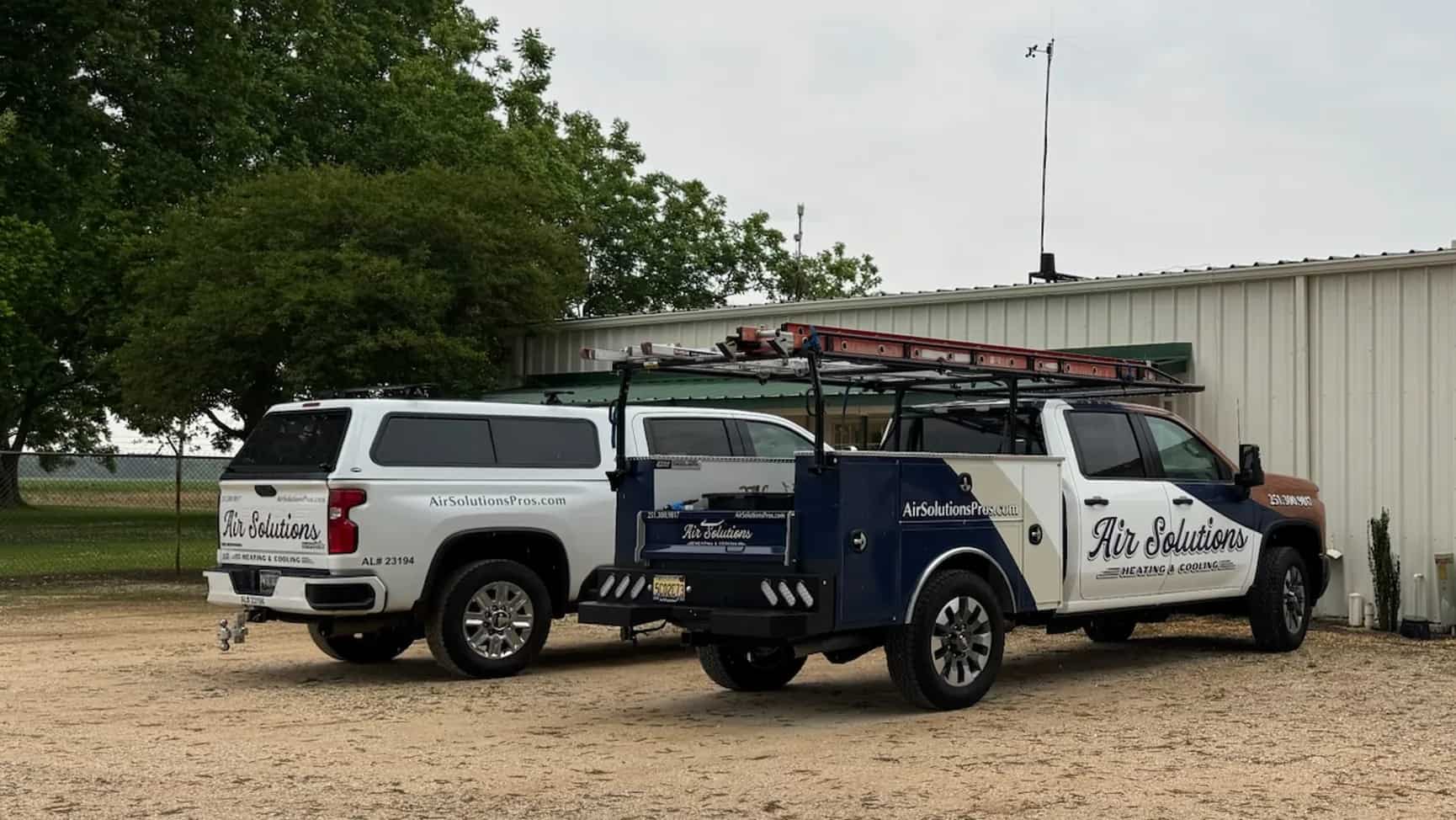
Heat Pump Services in Loxley.
Local heat pump services in Loxley, Alabama and surrounding Baldwin County. Repair, install, maintenance for Baldwin County's #1 system type. Licensed AL#23194. 353+ five-star reviews. Call (251) 300-9817.
Get a Free Estimate
Name and phone is all we need to call you back. Takes ~20 seconds.
353+ five-star reviews · Same-day · 24/7 · Licensed AL#23194
What heat pump services looks like in this climate.
The defining operating-life fact for a residential heat pump on the Loxley subdivision footprint is the cumulative compressor-hour load the equipment has already absorbed before any given winter cold snap actually arrives. The per-coordinate ERA5-Land reanalysis at the Loxley grid cell logs roughly 2,977 cooling degree days against a July average daily high of 91.5°F, and the cooling load runs hard from late April through mid-October on the inland envelope without the marine moderation that softens the Eastern Shore afternoons. A builder-spec single-stage heat pump installed during the 2008-2013 wave that filled the south-side subdivisions and the I-10 interchange residential build-out has now logged twelve to seventeen summers of that load before facing whatever this coming winter brings. The compressor itself is the part of the system that does not get easier with age, and the second-stage of operating life is where the cumulative cooling-mode hours start showing up as marginal performance in the heating-mode duty cycle that the equipment is far less practiced at.
The heating side of that same envelope is what makes the second-stage-life economic decision actually pressing rather than abstract. Loxley logs approximately 1,165 heating degree days against an average January low of 48.2°F — close to Bay Minette and Perdido on the annual count, which puts the local equipment squarely in the inland-Baldwin heating-profile band where the reversing valve actually swaps states for genuine stretches across December and January rather than for the handful of minutes a Gulf-front unit ever sees. A builder-spec heat pump that performed acceptably across its first ten years often hits its first compressor-stress winter somewhere in years twelve through fifteen, when the defrost cycle starts running longer than the original commissioning specified and the auxiliary heat strip stages in more often than the homeowner expects to see on the electric bill. That is the operating-life pattern that drives most of the heat-pump-services calls into the Loxley footprint in any given winter.
What we see on calls in Loxley.
The Loxley heat-pump service caseload organizes around three distinct equipment-and-age profiles that show up in the call queue with roughly predictable frequency. Profile 1 is the 2008-to-2013 builder-spec single-stage outdoor unit on a south-side subdivision address — the dominant cohort, now twelve to seventeen years into operating life. The recurring findings on this profile are the ones cumulative-hour wear actually produces: capacitor microfarad readings drifting below specification, contactor face condition showing meaningful pitting after a thousand-plus switching cycles, condenser-fan motor bearings developing audible play, and on the units past the fifteen-summer mark a slow refrigerant loss surfacing as gradual capacity decline that the homeowner notices first as longer runtime to reach setpoint rather than as a hard failure. The compressor itself is the part of the system where the economic decision actually concentrates on this profile, because a compressor swap on a fifteen-year-old single-stage outdoor unit competes directly against a full-system-replacement option whose math now includes second-decade efficiency improvements and available utility-rebate paths on qualifying replacements.
Profile 2 is the 2014-to-2018 two-stage or early-variable-speed outdoor unit, dominant on the newer south-side subdivisions that filled in during the post-Buc-ee's commercial-expansion wave. This cohort is now seven to eleven years into operating life and presenting a different mix of findings — control-board firmware-era quirks on the early variable-speed inverters, ECM blower motors entering their first failure window, and on the equipment that pairs with a programmable communicating thermostat a generation of intermittent control-network faults that produce intermittent no-heat or no-cool symptoms hard to chase without a scheduled tune-up to verify each component's communication signature. The economic-decision pressure on this profile is lighter than Profile 1 because the equipment is genuinely worth keeping in service if the failure mode is isolated to a single repairable component, but the heat-pump-specific service items here look different from the older single-stage cohort and the tune-up checklist runs longer on the communicating side.
Profile 3 is the light-commercial split system on the Tanger Outlets-adjacent retail corridor and the I-10 interchange commercial frontage — a smaller share of the call book than the residential subdivisions but a meaningfully different equipment profile. Commercial-grade splits on retail jobsites run extended operating hours during retail open hours, often paired with rooftop economizer ductwork that the residential service technician approach does not always handle cleanly. The recurring findings here trend toward contactor wear on the heavier-duty starts associated with retail cycling patterns, condenser-coil loading from the road-dust drift carried by the prevailing I-10 traffic, and the occasional refrigerant-line damage from rooftop ladder traffic during adjacent contractor work. The service relationship on a Tanger-adjacent retail tenant typically runs on a different cadence than the residential bi-seasonal rhythm — quarterly preventive visits paired with on-call response during retail hours.
- Mid-life equipment is the common profile in this area. Capacitor and contactor failures dominate the service-call mix.
- Long cooling season means compressors run heavy May through October. Annual maintenance pays for itself in compressor lifespan.
- Mild winters mean heat pumps cover the season comfortably without backup runtime in normal years. Cold-snap weeks expose undersized units.
Heat Pump Services in Loxley — the questions that come up.
- Our 2012 builder-spec heat pump just had a compressor failure. Should we swap the compressor or replace the full system on a Loxley subdivision address?
- On a 2012-vintage builder-spec single-stage outdoor unit that has now logged thirteen Baldwin County summers on a south-side subdivision slab, the compressor-swap-versus-full-replacement decision usually pencils out toward replacement, but the actual math depends on three things the on-site diagnostic verifies before the conversation is real: the condition of the indoor air handler and evaporator coil, the condition of the refrigerant line set, and whether the contactor, fan motor, and capacitor on the outdoor unit are themselves still in serviceable spec or whether the compressor failure was the first major component to give up among several that are close behind. A compressor swap on a thirteen-year-old single-stage outdoor unit typically costs a meaningful fraction of full-system replacement once the refrigerant recovery, drier replacement, evacuation, and weigh-in labor are included, and the swap leaves the remaining wear components (contactor, capacitor, fan motor, defrost board) on their original wear curve. A full-system replacement at current-generation efficiency tiers may qualify for available utility rebate programs and brings the indoor air handler and matched evaporator coil into the same warranty window as the outdoor unit. We write both estimates before any decision is made, so the homeowner sees the number both ways rather than under emergency-call pressure.
- We have a 2015 two-stage heat pump on a newer Loxley south-side subdivision and it's still working. Is a variable-speed upgrade worth it before this one actually fails?
- Probably not on a 2015 two-stage heat pump still running cleanly within commissioned specification on a south-side subdivision address. The variable-speed efficiency lift over a competently sized two-stage system is real but narrower than the marketing language suggests — variable-speed equipment runs longer cycles at lower compressor capacity to maintain tighter setpoint and humidity control, which produces meaningful comfort improvements and modest annual energy savings against the long humid Baldwin cooling season. The economic case for the upgrade gets stronger as the in-service equipment ages into the second-stage-life zone where major-component failures start concentrating, but a 2015 two-stage system in years ten of operating life is generally early for that conversation if the system is still holding setpoint, the refrigerant charge is stable, and the tune-up findings have been routine. The case shifts if the system has had multiple control-board or ECM-blower-motor repairs that signal the early-variable-speed cohort communication-network quirks, if the homeowner is planning to stay in the home for another fifteen-plus years, or if the household has a specific humidity-control or zoning requirement that two-stage equipment cannot deliver as cleanly. We run that conversation against the actual equipment and the actual household plan rather than against a generic efficiency-tier upgrade pitch.
- Our business is in the Tanger Outlets-adjacent retail corridor and we have a light-commercial split system. Is that the same service relationship as residential heat-pump service?
- Mechanically the equipment is closely related, but the service relationship is genuinely different in cadence, hours, and response expectations. A Tanger-adjacent retail tenant typically runs a quarterly preventive-maintenance cadence rather than the bi-seasonal cadence that defines the residential Cool Club rhythm, because the commercial-grade outdoor unit logs substantially more compressor hours per calendar year against retail open-hour cycling patterns and because a refrigerant-loss event during retail open hours creates customer-experience consequences a residential homeowner does not face on a Saturday at home. The on-call response side also runs differently — commercial tenants generally want next-business-day response during retail hours rather than the after-hours weekend response that the residential emergency line covers, and the contractor coordination on a rooftop unit often involves landlord-tenant communication about roof-access permissions and adjacent-contractor scheduling that does not exist on a residential ground-level outdoor unit. We service both equipment categories out of the same Daphne shop and the technician skill set overlaps cleanly, but the contract structure and the visit cadence are designed differently for the commercial side.
- What utility rebates or incentives are available on a Loxley heat-pump replacement right now?
- The federal Section 25C credit for qualifying heat-pump installations expired December 31, 2025. Installs placed in service in 2026 do not qualify; if your system was installed on or before that date, ask your tax preparer about the 2025 Form 5695. For current savings, Baldwin EMC and Riviera Utilities have historically run residential efficiency rebate programs for qualifying high-efficiency heat-pump replacements. The program menus, dollar amounts, and qualifying-equipment tiers both utilities change annually — we pull the current program sheet directly at quote time rather than carry a stale figure into the estimate. Tell us which utility is on your most recent electric bill and we will verify the current program before any incentive number goes on the written quote.
- The original builder for our 2010 subdivision is no longer in business. How do we handle equipment warranty on a heat pump that's still inside the manufacturer coverage window?
- The original-builder closure does not affect the manufacturer-side equipment warranty on heat-pump equipment that is still inside the coverage window, because the warranty runs from the manufacturer (Carrier, Trane, Lennox, Goodman, Rheem, York, Bryant, Amana) to the original purchaser based on the equipment serial number and the documented placed-in-service date, not from the builder. The manufacturer-warranty handoff on a builder-spec subdivision install typically requires the original purchaser to register the equipment within a defined window after install (often sixty to ninety days) to activate the longest available coverage period — homes where that registration was not completed at original install sometimes carry a shorter default coverage period instead. The maintenance-documentation requirement is the part that needs current attention regardless of the builder situation: most major manufacturers require documented annual professional maintenance as a condition of their equipment warranties, and a service report from each year of in-service operation is what defends a compressor-stage or major-component claim if one lands inside the coverage window. We pull the equipment serial numbers and the placed-in-service date at the first tune-up visit so the warranty status is clear before a major-component failure forces the question under pressure.
Every Loxley neighborhood, every zip.
Heat-pump-services coverage for Loxley spans the single 36551 ZIP out of the Daphne shop, with the bulk of the residential caseload concentrated on the south-side subdivisions that filled in around the original downtown core during the 2000s and 2010s commercial-corridor expansion. The route in measures 15.5 miles east on I-10 and OSRM puts the door-to-driveway time at roughly twenty-two minutes under normal traffic — the mid-county-fastest inland drive in our service area, shorter than the routes to Foley, Robertsdale, Bay Minette, Stockton, or any of the south-coast cells. The residential coverage anchors on the subdivision footprint south of Highway 59; the commercial side of the caseload anchors on the Tanger Outlets-adjacent retail corridor, the I-10 interchange travel-stop frontage, and the Highway 59 commercial spine that connects the two.
When a heat-pump service call surfaces a second-stage-life finding that pushes the conversation past a routine tune-up — a compressor that is starting to stage in long before it should, a defrost cycle that has lengthened past commissioned spec, a condenser-fan motor that has developed bearing play, a refrigerant charge that has been recovered and weighed in and is now reading low again within a single cooling season — the call back to (251) 300-9817 lets us set the second visit with the homeowner walking through the compressor-swap-versus-full-replacement decision math on the actual equipment in front of us. The equipment families that fill the Loxley subdivision footprint are the ones we service routinely: Carrier, Trane, Lennox, Goodman, Rheem, York, Bryant, Amana. We're not an authorized dealer for any single manufacturer, which means our recommendation on a second-stage-life replacement quote is based on what fits the home and budget rather than on a dealer incentive, and the equipment-tier conversation stays open across all eight families rather than collapsing onto whichever brand carries the current spiff.
A representative second-stage-life case the Loxley caseload sees regularly: a south-side subdivision homeowner with a 2012-vintage builder-spec single-stage heat pump that has been losing capacity gradually across the last two summers and stopped holding setpoint cleanly during the most recent multi-night sub-freezing stretch. The defrost cycle had lengthened past the original commissioning specification, the auxiliary heat strip was staging in on mornings it should not have, and the outdoor unit was running longer recovery times after each defrost. The service-call diagnosis isolated a slowly weakening compressor running against a marginal capacitor and an outdoor-fan motor entering audible bearing wear — three items each individually repairable but in aggregate signaling the equipment was past the economic threshold where another repair round made sense against the full-replacement option factoring in second-decade efficiency improvements and applicable utility rebates on a qualifying high-efficiency replacement. The conversation that followed walked the homeowner through compressor-swap economics versus current-generation two-stage and variable-speed replacement economics, with written estimates on both options before any decision was made under pressure. After-hours service tickets carry overtime rates per the published Air Solutions policy, disclosed before the truck rolls.
Cool Club membership covers the bi-seasonal tune-up cadence that heat-pump equipment specifically benefits from on the Loxley subdivision footprint — one cooling-side visit each spring on the equipment that worked the long summer, one heating-side visit each fall on the equipment that will work the inland-Baldwin winter — plus 15% off all AC repairs and 5% off new systems on any service or replacement work that follows. The maintenance discipline also carries a warranty dimension worth being plain about on second-stage-life equipment: most major manufacturers (Carrier, Trane, Lennox, Goodman, Rheem) require documented annual professional maintenance as a condition of their equipment warranties, so the written service report from each scheduled visit is the paper trail that keeps the warranty defensible if a compressor-stage failure lands inside the manufacturer coverage window. A $150 tune-up runs meaningfully cheaper than the after-hours service call that catches the same drift at 2 a.m. on a January Tuesday, and a $40 capacitor replaced during a tune-up runs meaningfully cheaper than the compressor it would otherwise stress to failure on the next cold snap.
- Downtown Loxley
- the I-10 corridor
- the Hwy 59 corridor
- Loxley Municipal Park area
- Hickory Street (US-90)
Weather events that pushed the Loxley subdivision heat-pump cohort across the second-stage-life decision threshold.
- Jan 2024 — Multi-night sub-freezing stretch — defrost-mode failures across the 2008-2013 cohort: Three consecutive nights below freezing with daytime highs barely cracking 40°F. The cold-soak runtime exposed the second-stage-life equipment on the south-side subdivision footprint that the milder recent winters had let coast — defrost cycles on 2008-to-2013 builder-spec single-stage outdoor units lengthened past commissioned specification, auxiliary heat strips staged in on mornings the compressor should have handled, and on a meaningful share of the cohort the diagnostic week after the cold snap surfaced compressor-or-condenser-fan-motor failures that pushed the conversation past routine service into full-replacement-quote territory. The post-event service-quote queue across the I-10 corridor subdivisions ran heavier on full-system replacement work than on capacitor-and-contactor service work, which is the operating-life signature of the cohort hitting the second-stage decision threshold roughly on schedule.
- Summer 2023 — Sustained above-95°F heat stretch — compressor-stress events on aging single-stage units: An extended above-95°F stretch in late summer clustered the cooling-side stress on the 2008-2013 builder-spec single-stage outdoor units across the south-side subdivisions. Units running marginal on a slow refrigerant leak, a weakening compressor, or a contactor with measurable face pitting hit the wall during the stretch, and the resulting tickets often pivoted toward full replacement on equipment that had logged twelve-to-fifteen summers of cooling-mode hours under the matrix-high inland CDD load. The Tanger-adjacent commercial corridor saw a parallel cluster on the rooftop split systems whose extended retail open-hour cycling concentrated the compressor stress earlier in the equipment life than the residential cohort.
- Sep 2020 — Hurricane Sally — dirty-power exposure on early-variable-speed inverter boards: Sally pushed inland with sustained tropical-storm-force winds along the I-10 corridor through Loxley and triggered a multi-day grid stand-up across the south-side subdivision footprint. The recovery cycle exposed the early-variable-speed inverter board cohort on the 2014-to-2018 install wave to dirty-power transient events that did not always surface as an immediate ticket but that produced a noticeable share of the replacement quote work written across late 2020 and 2021. The residual lesson on second-stage-life equipment is that surge-protection accessories at the outdoor disconnect are a worthwhile line item on any equipment that survived Sally and is now another five years deeper into operating life — the next dirty-power event lands on equipment that has already absorbed prior transient exposure.
What Loxley customers can claim.
- Baldwin EMC carries residential electric service across most of the south-side subdivision footprint that fills the Loxley heat-pump caseload, with some perimeter parcels on Riviera Utilities depending on the actual service-territory boundary at the address. The fastest confirmation is the letterhead on the most recent electric bill. On a second-stage-life replacement conversation triggered by a major service finding on a 2008-to-2013 builder-spec outdoor unit, that utility verification is the first item we nail down before any rebate-anchored numbers go on a written quote, because the two providers maintain separate residential energy-efficiency program menus with different qualifying-equipment lists.
- Baldwin EMC's residential energy-efficiency program is structured around qualifying full-system replacements at defined efficiency tiers rather than around parts-and-labor service work. A compressor swap on a thirteen-year-old single-stage outdoor unit does not generally match the program criteria; a current-generation variable-speed heat-pump installation at the program's qualifying tier typically does. Program windows shift annually on both equipment lists and dollar amounts, so we verify the current cooperative program directly through baldwinemc.com at the time of the replacement quote rather than carry a figure forward from a prior season.
- Any manufacturer rebate active during the quote window — periodic seasonal promotions from Carrier, Trane, Lennox, Goodman, Rheem, York, Bryant, or Amana on qualifying installations — gets applied to the project price up front during the quote process rather than routed through a separate post-install claim. The quote stacks the manufacturer rebate, the cooperative-side rebate where applicable, and presents the equipment-only price alongside the post-incentive net so the second-stage-life decision math is visible end-to-end on the same document.
Heat Pump Services Coverage Map — Loxley, Alabama
Centered near Loxley for orientation. Air Solutions Heating & Cooling provides heat pump services throughout every Loxley neighborhood and zip code, plus the surrounding Baldwin County area. Same crew, same number — we travel the whole county.
353+ Five-Star Reviews. And Counting.
“Jacob was friendly, professional and prompt.”
“Jacob was absolutely wonderful. Definitely would recommend him and this company!!”
“⭐⭐⭐⭐⭐ **Outstanding Service from Air Solutions and Jesse!** I can't say enough good things about my experience with **Air Solutions**, especially their technician **Jesse**. After dealing with my 10-year-old HVAC system, I wanted someone who would actually take the time to diagnose and properly service the system rather than simply recommend replacing it. Jesse exceeded my expectations. He was…”
Schedule Heat Pump Services in Loxley.
Repair, install, maintenance for Baldwin County's #1 system type. Same-day appointments most weekdays in Loxley and surrounding Baldwin County. Tell us when works for you — we'll confirm by phone during weekday office hours (8 AM-4 PM).
Need someone right now? Call (251) 300-9817 — our 24/7 emergency line is answered live when we can and returned quickly when we can't.
Heat Pump Services in Loxley — FAQs
Why are heat pumps the most common HVAC system in Baldwin County?
Baldwin County's mild winter climate (Climate Zone 2A) is ideal for heat pump operation. Heat pumps deliver 2-3 units of heat for every unit of electricity consumed in our typical winter conditions, while also providing all the summer cooling. One outdoor unit, both seasons, lower utility bills than separate AC + gas furnace setups in our climate. Alabama Power and TVA EnergyRight rebate programs may apply to qualifying high-efficiency installs.How long do heat pumps last on the Gulf Coast?
Inland Baldwin County heat pumps (Daphne, Fairhope, Spanish Fort, Bay Minette) typically last 12-15 years with bi-annual maintenance. Coastal heat pumps (Gulf Shores, Orange Beach, Fort Morgan) typically last 8-12 years due to salt-air corrosion. Coastal-grade outdoor units with corrosion-resistant coatings extend coastal lifespan to 12-16 years. Cool Club bi-annual maintenance documented for warranty purposes maximizes equipment life.Is the federal 25C tax credit still available for heat pump installations?
No — the federal 25C Energy Efficient Home Improvement Credit expired December 31, 2025. Heat pump systems placed in service in 2026 or later are not eligible. If your system was installed on or before December 31, 2025, the credit may be available on your 2025 federal return — verify with a CPA. For new 2026 installs, ask about Alabama Power, TVA EnergyRight, and manufacturer rebate programs that remain in effect.Do you service all of Loxley, AL?
Yes — Air Solutions Heating & Cooling covers every neighborhood and zip code in Loxley, Alabama — including Downtown Loxley, the I-10 corridor, the Hwy 59 corridor, plus the surrounding subdivisions and rural roads. We handle AC repair, AC installation, AC maintenance, emergency HVAC, and commercial HVAC. Standard service hours weekdays, 24/7 emergency response, and same-day appointments most of the year. Call (251) 300-9817 to schedule.What HVAC issues are most common in Loxley?
Homes around I-10 most commonly call us for refrigerant leaks (often salt-air or coil corrosion related on the Gulf Coast), undersized air conditioning systems struggling with Baldwin County summer humidity, and capacitor failures during peak load between June and September. A Cool Club bi-annual maintenance plan catches most of these issues before they cause a breakdown.
Heat Pump Services Near Loxley.
Right at the Loxley city limit? We service the surrounding Baldwin County communities on the same routes — same crew, same response times.
Related HVAC Guides.
Long-form articles about heat pump services and Baldwin County HVAC, with practical advice from our team.
 Commercial
Loxley Restaurant HVAC: Surviving Peak Summer Service Without Failures
Restaurant HVAC priorities for Loxley, AL operators during peak summer — service contracts, makeup air balance, and avoiding the Friday-night failure scenario.
September 10, 20265 min Maintenance
Why Your AC Is Blowing Warm Air in Loxley: 4-Step Troubleshooting Guide
Step-by-step troubleshooting for AC blowing warm air in Loxley, AL homes — four DIY checks before calling, plus what each common cause involves to repair.
August 25, 20264 min Maintenance
AC Drain Line Clogs in Humid Loxley: Causes, Fixes, and Prevention
Why AC drain lines clog in Loxley, AL homes — what causes it, the 15-minute DIY flush that prevents most clogs, and when professional cleaning is required.
April 18, 20264 min
Other services in Loxley & this service across Baldwin County.
- All HVAC services in Loxley, AL
- Heat Pump Services across Baldwin County
- AC Repair in Loxley
- AC Installation in Loxley
- AC Maintenance in Loxley
- Commercial HVAC in Loxley
- Emergency HVAC in Loxley
- Heating Repair in Loxley
- Indoor Air Quality in Loxley
- Ductless Mini-Splits in Loxley
- Heating Installation in Loxley
Heat Pump Services in Loxley — Schedule Today.
Same-day appointments most weekdays. Cool Club members get prioritized scheduling.