
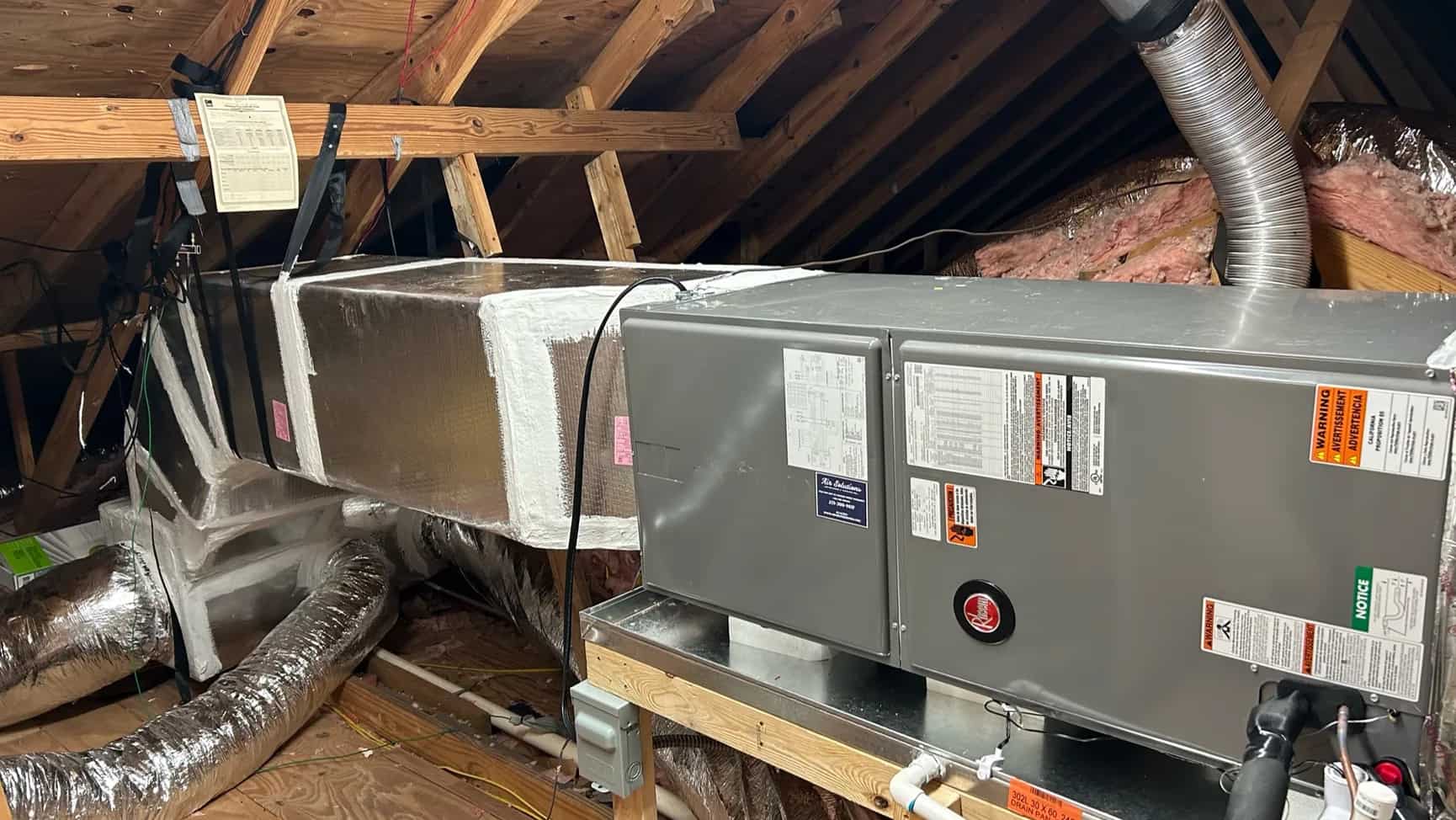
Ductless Mini-Splits in Foley.
Local ductless mini-splits in Foley, Alabama and surrounding Baldwin County. Zone cooling for additions, garages, sunrooms, historic homes. Licensed AL#23194. 366+ five-star reviews. Call (251) 300-9817.
Get a Free Estimate
Name and phone is all we need to call you back. Takes ~20 seconds.
366+ five-star reviews · Same-day · 24/7 · Licensed AL#23194
Every Foley neighborhood, every zip.
From the Daphne base the dispatch run lands central Foley in roughly 40 minutes by the OSRM routing — close to 26 miles south down US-98 and Highway 59 — which puts both ZIPs 36535 and 36536 inside the same coverage band we run for any other south-central Baldwin destination on a ductless project. The neighborhoods that show up most consistently on the Foley call book run across the city: Glenlakes and Liveoak Village on the 1990s-built interior where the ductwork-replacement-vs-conversion conversation surfaces most often, Magnolia Place and Cypress Gates and Pebble Creek and Parish Lakes through the 2000s subdivision belt, Graham Creek Estates and Leisure Lake on the east-side parcels, and the Bon Secour and Wolf Bay Estates lakefront homes where the lakeside bonus-room work concentrates.
Mini-split work runs a different scheduling rhythm than a same-day central-system repair call. A multi-zone install project typically breaks across a pre-install assessment visit, a one-or-two-day install with refrigerant work and electrical work that benefits from staged rather than compressed scheduling, and a commissioning follow-up after the system has logged a few weeks of runtime. For a single-zone install on a Wolf Bay bonus room or a Hwy 59 back office the entire project can complete in a single full day; for a four-zone Glenlakes ductless conversion the install is staged across two consecutive days.
- Glenlakes
- Magnolia Place
- Liveoak Village
- Graham Creek Estates
- Leisure Lake
- Cypress Gates
- Parish Lakes
- Pebble Creek
- Wolf Bay Estates
What we see on calls in Foley.
Foley's housing distribution looks tri-modal when you walk the call book rather than bimodal the way Fairhope reads. On one side sit the 1990s subdivision homes around Glenlakes and Liveoak Village — central HVAC in place from original construction, flex-duct trunk and branch runs entering their fourth decade, and a meaningful share of attic ductwork that's accumulated compression and pinhole-leak loss across enough sections to make a complete ductwork replacement quote start approaching the cost of a multi-zone ductless conversion. On a second tier sit the 2000s and early-2010s subdivisions through Magnolia Place, Cypress Gates, Parish Lakes, and Pebble Creek, where the original ductwork is still in good shape but the central system is hitting its replacement window. And on a third tier sit the older Bon Secour homes, the downtown-adjacent stock, and the Wolf Bay Estates lakefront homes — some of which genuinely never had central ductwork in their original build, some of which have additions that the central system was never extended to reach.
The Wolf Bay frontage carries its own ductless scenario that doesn't show up at the same intensity elsewhere in Foley. Multi-story lakefront homes with upper-level bonus rooms, enclosed dock-side porches being converted to climate-controlled living space, and guest-suite additions over the original footprint all produce single-zone or dual-zone install opportunities that a central-system extension would handle clumsily if at all. Sizing on these lakefront additions typically lands at 12,000 to 24,000 BTU/hr per zone depending on the envelope and orientation to Wolf Bay, with line-set routing to a ground-level outdoor pad on the inland side of the lot rather than the bay-facing side. The Hwy 59 corridor light-commercial scenario rounds out the local call mix — boutique-retail and storage-room back-office spaces where the landlord-furnished central system holds setpoint on the public sales floor but leaves the back office five to eight degrees warmer in peak summer, and the tenant wants a single-zone wall-mount that handles the supplementary load without major HVAC modification.
Service-side patterns on existing Foley ductless equipment cluster around a short list. Indoor-head condensate drain clogs lead the repeat-visit mix because the long humid cooling season keeps the evaporator coil wet for most of the year, and ceiling-cassette and high-wall indoor units both have shorter drain paths than a central air handler does — an annual drain-line treatment at the spring tune-up heads off most of those calls. Inverter board-level electronics failures show up more often on systems running without surge protection at the outdoor disconnect, with the typical pattern being a thunderstorm-driven voltage transient that takes out the control board on an outdoor unit that survived the actual storm without physical damage. Refrigerant-leak diagnostics on multi-zone systems get worked through the manufacturer-published leak-search protocol for the specific lineup rather than general AC habits that don't map cleanly onto a multi-zone refrigerant circuit.
- Mid-life equipment is the common profile in this area. Capacitor and contactor failures dominate the service-call mix.
- Long cooling season means compressors run heavy May through October. Annual maintenance pays for itself in compressor lifespan.
- Mild winters mean heat pumps cover the season comfortably without backup runtime in normal years. Cold-snap weeks expose undersized units.
Ductless Mini-Splits in Foley — the questions that come up.
- Our 1990s Glenlakes home has original flex-duct attic runs that are leaking, and a contractor quoted complete ductwork replacement at a number that surprised us. Does converting to a multi-zone ductless system actually make sense at this point?
- This conversation comes up often enough on 1990s-built Foley homes that we walk a structured framework through it rather than answer reflexively. The comparison hinges on three numbers. First, the realistic quote for complete ductwork replacement on the existing house — typically trunk, branch runs, return-grille re-cuts, and any vapor-barrier rework once the original insulation comes out. Second, the quote for a multi-zone ductless conversion sized to match the existing room count — typically three to five indoor heads paired to a single outdoor inverter unit, with the existing central air handler decommissioned and the ductwork either pulled or capped in place. Third, the projected operating-cost delta between a new central system reusing the replaced ductwork versus a multi-zone inverter ductless system running variable-capacity through the long Foley cooling season. On a Glenlakes-era house where the ductwork replacement quote is in the same ballpark as the ductless conversion quote, the operating-cost math over the next decade typically favors the ductless route. On a house where the ductwork is mostly intact and only one or two trunk sections need attention, the central-system replacement is usually the cleaner answer. We bring both quotes to the kitchen-table conversation and walk the math openly rather than push a single answer.
- We're adding an upper-level bonus room over our Wolf Bay lakefront house and the central system can't reach it. What size mini-split do we need, and how do we route the line set without ruining the lake view?
- Wolf Bay bonus-room additions are one of the most common Foley ductless scenarios on the lakefront side of the city. Sizing depends on the envelope, ceiling height, and window orientation toward the bay — but a typical bonus-room addition of 300 to 500 square feet with reasonable insulation, double-pane windows, and a single exposure to lake-side glazing usually lands at a 12,000 to 18,000 BTU/hr single-zone configuration. If the addition includes both a bonus room and a separate guest suite or office, a two-zone setup with a smaller indoor head in each space tends to work better than a single oversized head. On the line-set routing question, the practical answer is that we position the outdoor unit on the inland side of the lot rather than the bay-facing side — both to keep the lake view clean and to protect the equipment from the brackish Wolf Bay aerosol load, which is milder than open-Gulf salt exposure but real enough to matter on a decade-plus equipment lifespan. The refrigerant line set then routes through an exterior chase down the inland-facing wall to the outdoor pad.
- I run a small retail shop in the outlet area near Tanger and the back office gets miserably hot in summer even though the main sales floor is fine. Can a single mini-split handle the back office without the landlord getting involved?
- The Hwy 59 corridor back-office heat-loading complaint is a recurring scenario on the small-retail and boutique side of the Foley commercial inventory, and a single-zone ductless wall-mount is typically the cleanest fix. The mechanical answer is that the landlord-furnished central system was sized for the public sales-floor load and routed to the registers and main display area, with the back office and storage room either downstream of the supply trunk or served by an undersized branch run. A single-zone mini-split at 9,000 to 18,000 BTU/hr — sized to the back-office square footage, ceiling height, and any heat-load contribution from server racks or point-of-sale equipment — handles the supplementary cooling without touching the landlord's central system. The lease-review side is the part to confirm before installing: most commercial leases allow tenant-funded HVAC supplementation with landlord notification or written consent, and we put the proposed scope in writing for landlord review as part of the proposal.
- Our address shows up on both Riviera Utilities and Baldwin EMC depending on who we ask. Which rebate program applies to a new ductless install, and how do we confirm which one serves us?
- Riviera Utilities is the dominant electric and natural-gas provider across the Foley ZIPs of 36535 and 36536, with a smaller share of perimeter meters falling on Baldwin EMC instead — the boundary runs through some edge subdivisions and the answer for any specific address really does depend on the parcel rather than the neighborhood as a whole. The fastest confirmation is the masthead on the most recent electric bill, which carries the provider name clearly. Both Riviera and Baldwin EMC have run residential efficiency rebate menus in past program years for high-SEER2 and high-HSPF2 ductless heat-pump installations, but the qualifying-equipment tiers and the specific dollar figures shift annually and don't always cover the same equipment in the same way. We verify the active program menu with whichever utility serves the meter at the time of the install consultation rather than carry a stale rebate number into the project budget.
- If we put a new ductless system in, does it make sense to add a Cool Club maintenance plan from day one or should we wait until something breaks?
- On a brand-new ductless install the case for adding Cool Club from day one rests on a specific manufacturer-warranty consideration rather than a general comfort-spend argument. A bi-annual tune-up cadence (spring cooling-mode check, fall heating-mode check) satisfies that documentation requirement and produces a paper trail the manufacturer will accept against a future warranty claim. Cool Club covers exactly those two annual visits, and members carry the discount path of 15% off all AC repairs and 5% off new systems on related line items through the membership year. The mini-split-specific upside is that the indoor-head fan-wheel cleaning, condensate drain treatment, and outdoor-coil rinse all happen on the right cadence rather than getting skipped — those three items are the biggest controllable factors on ductless lifespan in the Foley climate.
- When does a ductless mini-split make sense for a Baldwin County home?
- Five common Baldwin County scenarios: (1) garage conversions, sunrooms, or additions with no existing ductwork; (2) detached structures like workshops or pool houses; (3) historic homes (Olde Towne Daphne, downtown Fairhope, Magnolia Springs cottages) where retrofitting central ductwork would be invasive; (4) one specific room that won't cool properly with central AC; (5) vacation rentals with variable occupancy where per-zone control matters. For most other situations, traditional central air is more cost-effective.
What ductless mini-splits looks like in this climate.
Foley sits in south-central Baldwin County roughly 25 meters above sea level, far enough inland from the Gulf-front salt envelope to escape the worst of the coastal corrosion timeline but still firmly inside the Gulf-Coast cooling envelope. The local 2023 ERA5 reanalysis posts roughly 3,034 hours of cooling demand to about 1,065 hours of heating demand at the city-center coordinate, with average July highs settling near 90.8°F and average January lows around 49.5°F. For a ductless mini-split the practical implication is that the inverter compressor spends roughly nine months of every year inside its highest-efficiency operating band — long shoulder seasons where the system modulates continuously at 30 to 70 percent of nameplate capacity, holding both temperature and dewpoint steady against a partial sensible load that would have a single-stage central system short-cycling itself into a humidity problem.
The 1,065-hour heating side is small in proportional terms but real in absolute terms — meaningfully larger than Gulf Shores, Orange Beach, or Fort Morgan, where the heating-mode load barely registers on the operating profile. In Foley a heat-pump mini-split actually has to do work in heating mode across cold-front weeks each November through February, and the cold-climate rating on the outdoor inverter matters here in a way it doesn't matter on the southern beach cities. Entry-tier lineups rated to about 5°F handle nearly every Foley winter morning without auxiliary draw; the hyper-heat lineups from Mitsubishi, Daikin, and Fujitsu earn their premium on the once-a-decade hard-freeze stretch.
Storm and freeze events that have shaped how we install and service ductless systems in Foley.
- Sep 16, 2020 — Hurricane Sally: Sally tracked an inland wind field through south-central Baldwin with multi-day power-restoration timelines across Foley. The ductless-specific aftermath ran in two phases. Wind-driven debris damage on outdoor inverter units showed up immediately on installs without protective screens or wind-rated mounting, with bent fin packs and cabinet-panel impacts that often required full outdoor-unit replacement. The slower-burn pattern was voltage cycling during the multi-week grid recovery, which knocked out inverter control boards on outdoor units that lacked surge protection at the disconnect — a wave of board-replacement calls clustered into early 2021.
- Sep 16, 2004 — Hurricane Ivan: Ivan reset both the housing stock and the original-equipment HVAC inventory across substantial portions of incorporated Foley. The 2005-2008 rebuild wave is part of why the central-system replacement-cycle conversation today on a Foley address is so heavily weighted toward second-generation replacement. The post-Ivan rebuild wave largely predates the modern multi-zone ductless lineup, so the ductless installs in Foley today are almost entirely first-generation equipment going onto homes whose original central system is at or past its useful service life — as a full replacement, as a retrofit conversion off failing ductwork, or as an addition layer for spaces the original central system never reached well.
- Jan 2024 — Multi-night hard-freeze stretch: A stretch of sub-freezing overnight lows long enough to put genuine heating-mode load on every heat-pump system in south-central Baldwin for several consecutive days. Properly-spec'd hyper-heat-rated ductless lineups held setpoint through the week without leaning heavily on auxiliary resistance heat, which on a Foley install matters because the heating-side load (1,065 HDD on the ERA5 baseline) is small enough across the typical winter that a budget-tier ductless system can look fine for years and then fail during the rare cold-stretch week.
What Foley customers can claim.
- Riviera Utilities serves most Foley addresses across both ZIPs for electric service, and reaches a substantial portion of the city for natural gas distribution.
- Both Riviera Utilities and Baldwin EMC have run residential efficiency rebate menus in past program years for high-SEER2 and high-HSPF2 ductless heat-pump installations.
- Natural gas service from Riviera Utilities reaches enough of Foley that a dual-fuel central system remains an option for any address with active gas distribution, but on a pure ductless install the configuration is by definition all-electric.
- The federal Section 25C Energy Efficient Home Improvement Credit expired December 31, 2025 and no longer applies to new ductless installations in 2026.
Ductless Mini-Splits Coverage Map — Foley, Alabama
Centered near Foley for orientation. Air Solutions Heating & Cooling provides ductless mini-splits throughout every Foley neighborhood and zip code, plus the surrounding Baldwin County area. Same crew, same number — we travel the whole county.
366+ Five-Star Reviews. And Counting.
“Great service, professional and knowledgeable”
“Service Air came and replaced my evaporator coil quickly and efficiently. I chose them over another company after meeting with and being impressed with their tech Jessie. I also signed up for their maintenance plan due to their service capability.”
“Excellent service”
Schedule Ductless Mini-Splits in Foley.
Zone cooling for additions, garages, sunrooms, historic homes. Same-day appointments most weekdays in Foley and surrounding Baldwin County. Tell us when works for you — we'll confirm by phone during weekday office hours (8 AM-4 PM).
Need someone right now? Call (251) 300-9817 — our 24/7 emergency line is answered live when we can and returned quickly when we can't.
Ductless Mini-Splits Near Foley.
Right at the Foley city limit? We service the surrounding Baldwin County communities on the same routes — same crew, same response times.
Related HVAC Guides.
Long-form articles about ductless mini-splits and Baldwin County HVAC, with practical advice from our team.
 Buyer Guides
Mini-Split Zoning for Foley Bonus Rooms and Garages
The hot bonus room over the garage is a Foley, AL classic. How single- and multi-zone mini-splits reach the rooms central air can't — and how each zone gets sized.
July 23, 20266 min Seasonal
The Best Time of Year to Install a New Heating System in Foley
Why timing your Foley heating install for the shoulder seasons beats waiting for a January breakdown — a month-by-month look at the smart window.
October 28, 20265 min Comparison
Heat Pump or Gas Furnace in Foley? Sorting the 2026 Tradeoffs
In Foley's fast-growing all-electric subdivisions, the heat-pump-versus-gas-furnace question often answers itself. Here are the real tradeoffs.
October 19, 20265 min
Other services in Foley & this service across Baldwin County.
Ductless Mini-Splits in Foley — Schedule Today.
Same-day appointments most weekdays. Cool Club members get prioritized scheduling.