
Choosing the Right AC Size for Your Orange Beach Home: Manual J Explained
Why AC sizing matters more in Orange Beach, AL than inland — what Manual J load calculation does, why rule-of-thumb fails coastal homes, and what oversized AC costs you.

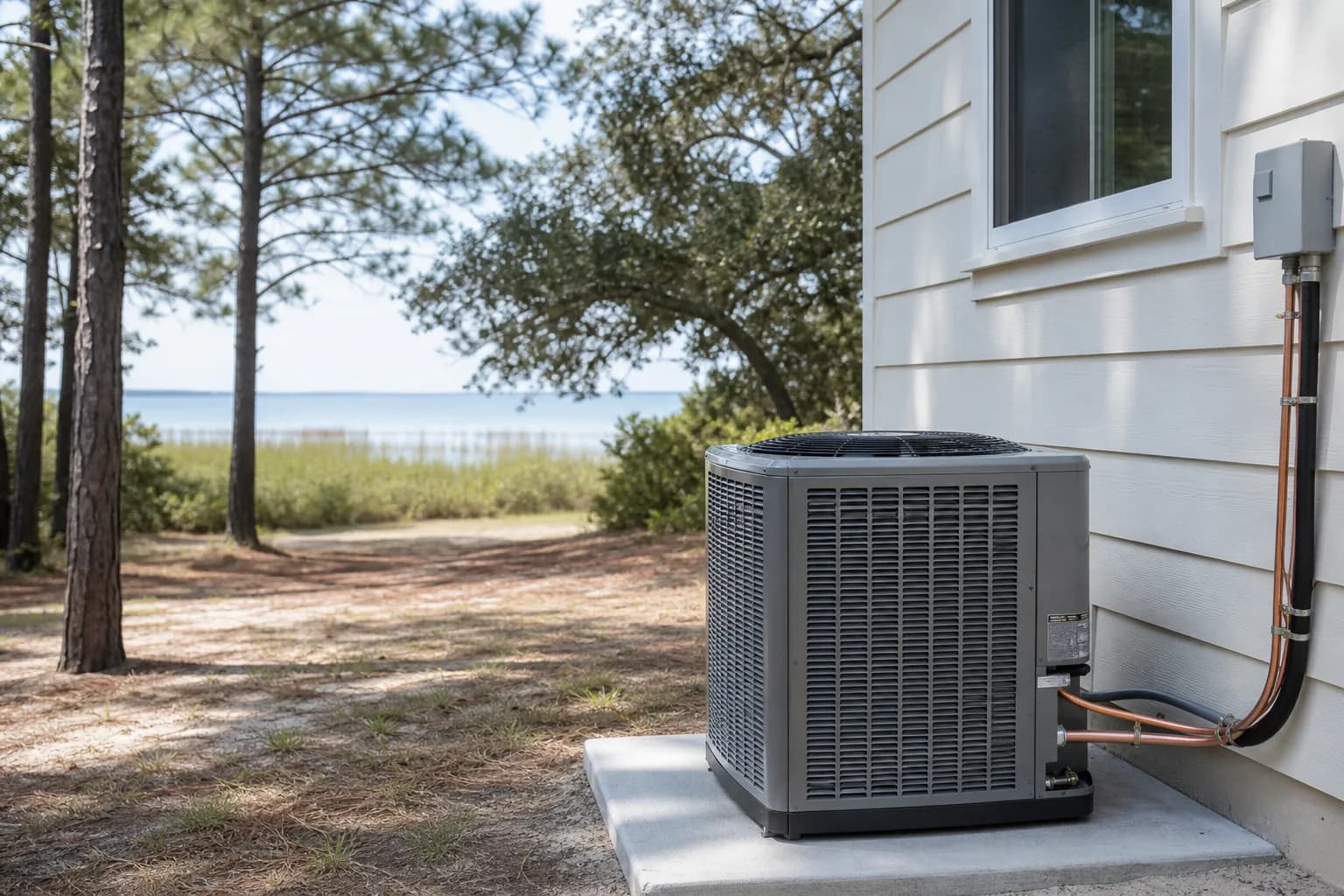
The single biggest mistake we see in Orange Beach AC installations is wrong sizing — almost always oversized. The system cools the house quickly but feels sticky, cycles on/off frequently, and shortens its own life. The fix is a Manual J load calculation: the industry-standard method for sizing HVAC equipment to a specific home.
Here's what Manual J does, why it matters specifically in Orange Beach, and how to make sure you get one.
What Manual J actually calculates
Manual J is a detailed heat-load calculation developed by ACCA (Air Conditioning Contractors of America). For each room in your home, it accounts for:
- Square footage and ceiling height
- Window orientation and glazing type (U-factor, SHGC)
- Wall and ceiling R-values (insulation effectiveness)
- Air infiltration rate (how much outdoor air leaks in)
- Door type and exposure
- Internal heat gains (people, lights, appliances)
- Local climate data (temperature, humidity, dew point)
The calculation produces a number in BTU/hour for cooling and heating. That number tells the installer what tonnage system actually fits your home.
Why rule-of-thumb sizing fails Orange Beach
The lazy method — "1 ton per 500 square feet" — assumes your house has average insulation, average windows, average air sealing, in an average climate. None of those are true in Orange Beach.
Specific Orange Beach reality — and it varies from the Perdido Pass condos to the single-family homes out on Ono Island:
- Salt-air corrosion on outdoor units doesn't affect sizing but affects equipment life expectations, and it's worst on the water — Cotton Bayou, Terry Cove, and the Gulf-front strip
- Hurricane-rated windows and doors common in newer construction reduce heat load significantly
- Coastal humidity means dehumidification load is huge — your "cooling tons" might be smaller, but your dehumidification need is large
- Sun exposure on south and west elevations of beachfront properties is intense
- High ceilings in vacation rentals add cooling volume
- Open floor plans with lots of glass have unique heat-load patterns
A rule-of-thumb sizing on an Orange Beach home typically results in equipment 0.5-1.5 tons larger than actually needed. The installer thinks "bigger is safer." The homeowner pays for it for the next 12 years.
What oversized AC does to comfort
Symptoms of oversized AC in Orange Beach homes:
- House cools fast but feels clammy — temperature setpoint reached without removing humidity
- AC cycles on/off frequently — every 5-10 minutes during cooling season
- Indoor humidity sits at 60%+ despite AC running often
- Some rooms cold, others warm — short cycles don't allow air to balance
- High utility bills — inrush current at every cycle adds up
- Premature compressor failure — short cycling roughly halves compressor life
The annoying part: many oversized systems "work fine" — they keep temperature within a few degrees of setpoint. The comfort and equipment-life cost is invisible until you realize your house doesn't feel as good as your neighbor's properly-sized one.
What Manual J reveals on real Orange Beach homes
Some real Manual J results we've run on Orange Beach properties:
Example 1: 2,400 sq ft single-family on second-row beach lot
- Rule of thumb: 4.5-5 tons
- Manual J actual: 3.5 tons (better-than-average insulation, modern windows, west-facing exposure factored)
- Result: properly-sized 3.5-ton variable-speed system runs longer cycles, dehumidifies effectively, lower utility bills
Example 2: 1,800 sq ft beach condo
- Rule of thumb: 3.5 tons
- Manual J actual: 2.5 tons (high SHGC windows on Gulf side, but small total exposure; building-shared cooling effect)
- Result: 2.5-ton system perfectly adequate; bigger would short-cycle constantly
Example 3: 4,200 sq ft new construction beachfront
- Rule of thumb: 7-8 tons
- Manual J actual: 5 tons (impact glass, spray-foam insulation, hurricane-rated envelope all reduce load)
- Result: 5-ton system runs steady-state; oversized 7-ton would have humidity issues
The pattern: modern Orange Beach construction with proper insulation almost always sizes smaller than rule-of-thumb suggests.
How to make sure your installer does Manual J
When getting quotes, ask:
- "Can I see the Manual J for this house?" Real Manual J produces a multi-page document with room-by-room load tables.
- "What software did you use?" Wrightsoft Right-J, Elite RHVAC, and Manual J 8 are common. Generic spreadsheets are NOT Manual J.
- "What were the heat-load and cooling-load numbers?" Should be specific BTU/hr figures for each.
- "What's the variable-speed equivalent if we go that direction?" Tests whether the installer thinks about humidity capacity.
If the contractor says "I've done this 30 years, I know what size you need" without producing paperwork — that's a red flag. Walk away.
Why this matters more for Orange Beach than inland
Three factors compound:
1. Humidity is the silent comfort killer. Inland Atlanta homes can run "comfortable" at 60% humidity because ambient temperatures are moderate. Orange Beach summer needs humidity below 55% to feel comfortable. Oversized AC can't deliver this.
2. Vacation rental economics. Guest reviews mention humidity ("sticky," "muggy") even when temperature is fine. Rental owners with properly-sized variable-speed equipment have higher reviews and bookings.
3. Equipment life in coastal environments. Oversized + short-cycling + salt air = equipment that fails at year 6 instead of year 12. On a Gulf Coast lot — whether you're near the Wharf or back along Bear Point Estates — getting sizing right pays back several times over.
What proper sizing looks like in practice
For a typical Orange Beach single-family home, a quality install comes down to a few pieces working together:
- A Manual J calculation — sometimes billed as a standalone engineering service, but most quality installers include it with the quote (we fold ours into the free in-home consultation)
- A properly-sized variable-speed system, AHRI-matched to your home's actual load
- Coastal-grade equipment specified for the salt-air environment
The alternative — an oversized rule-of-thumb install — often costs about the same to put in, but you pay for it afterward in humidity problems, short-cycling, and premature failure. Worse, many of those homes end up needing a whole-house dehumidifier added later just to fix the comfort the right size would have delivered from day one.
The Manual J pays for itself by preventing the wrong purchase decision. (A note on taxes: the federal 25C credit expired after 2025 and no longer applies to new installs — confirm your situation with a CPA.)
Ready for proper AC sizing in Orange Beach?
Air Solutions Heating & Cooling runs Manual J load calculations on every Orange Beach quote — no exceptions. Coastal-grade equipment standard. AHRI-matched components. Free in-home consultation.
- Schedule a Quote — free in-home consultation
- Call (251) 300-9817 — same-day quotes
- AC Installation services — full overview
Related resources
- AC Installation in Orange Beach — city-specific service page
- All HVAC services in Orange Beach — every service locally
- HVAC Glossary — definitions for Manual J, BTU, SEER2
- why Orange Beach installers insist on AHRI-matched components — matching the system to the load you just sized
- builder-grade vs premium in Orange Beach new construction — choosing the equipment tier for a waterfront build
- Manual J sizing for a Gulf Shores home — the same sizing discipline on the next beach over